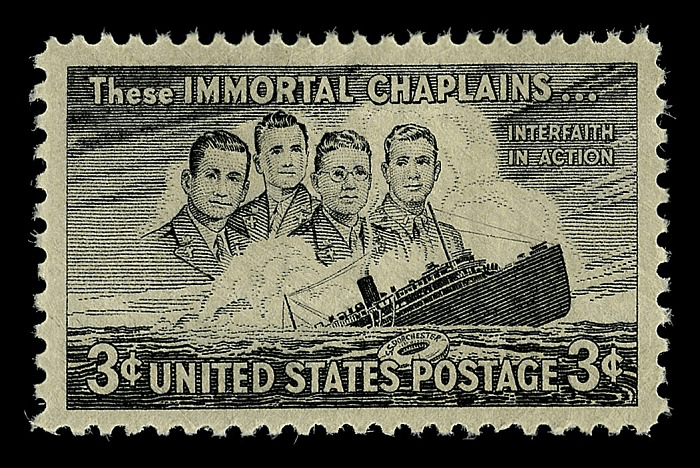
Jarred out of their sleep, when a torpedo pierced the ship’s steel hull, most of the passengers and crew tumbled from their crowded bunks onto the hard metal deck. Immediately cast into complete darkness as all electrical systems failed, those berthing in the lower holds faced a confused nightmare of flailing bodies and panic as the cold waters of the north Atlantic began rushing into their compartments. With the ship listing heavily to the port side, they struggled to find a way up and out. Many never made it. Those that did searched frantically for a place on one of the too few lifeboats. Spaces were at a premium. Within minutes, many who attempted to swim away from the sinking ship to avoid the downward suction succumbed to the numbing cold waters. Of the 904 passengers and crew, only 230 survived.[1] The American troop transport ship SS Dorchester had fallen prey to the German submarine U-223 at 00:55 AM, February 3, 1943.[2]
Listed among the ship’s passengers were four military chaplains, Methodist minister George L. Fox, minister Clark V. Poling of the Reformed Church in America, Catholic priest John P. Washington, and Rabbi Alexander B. Goode.[3] As men staggered up from below into the chilly night air they scrambled for footing on the slanted deck. Calmly, the chaplains guided them into the available lifeboats, and assisted the injured, helping them find places. As life jackets were also at a premium, the chaplains gave theirs to those who had none. Witnesses attest to the fact that as the ship slowly slipped beneath the dark Atlantic waters, the chaplains appeared standing, with arms linked, peacefully singing hymns and saying prayers. They perished as the Dorchester went down.
As Jesus had commanded, “Greater love has no man than this: that a man lay down his life for his friends.” (John 15:13) Without hesitation, abiding by these words, the chaplains acted to place the lives of those they could assist above their own. With certain death facing them, and with little time to weigh any decision, they moved as God had willed. The moment resonated also with Paul’s words of counsel to the Philippians, “Do nothing from selfishness or conceit, but in humility count others better than yourselves.” (Philippians 2:3) For the least of those among them, the chaplains did this and placed others above themselves in those very dark desperate minutes knowing that death was at their side.
Since the time of the Dorchester’s sinking, the selfless acts of the four chaplains have received commemoration in a number of ways. In 1948, Congress established February 3rd as “Four Chaplains’ Day,” and the US Postal Service issued a 3 cent stamp bearing the images of the four chaplains. At the dedication of the Chapel of the Four Chaplains in February 1951 in Philadelphia, President Harry S Truman opened his comments by noting, “This chapel commemorates something more than an act of bravery or courage. It commemorates a great act of faith in God.” He then reflected that, “They were not afraid of death because they knew that the word of God is stronger than death. Their belief, their faith, in His word enabled them to conquer death.”[4] These words resonated in the minds of most Americans during those dark postwar years when the United States found itself locked in an ideological struggle with the forces of Communist atheism.
A decade later, an act of Congress created the Chaplain’s Medal for Heroism, which the Secretary of the Army, Wilber M. Brucker, presented to the chaplains’ next of kin on January 18, 1961.[5] Today, a number of memorials in various locations across the country honor these four men including one in the shape of a dove in the National Memorial Park, Falls Church Virginia, and a stained glass window at the public library in East Rutherford, NJ. Additionally, a statue that features a likeness of the chaplains praying on the deck of a sinking ship stands outside St. Stephen’s Church in Kearney, NJ.[6] Still, unique among the commemorations were the comments shared by the former Kriegsmarine First Officer of the U-223, Gerhard Buske. Attending an Immortal Chaplains Foundation ceremony in 2004, he reminded all present that “we ought to love when others hate…we can bring faith where doubt threatens; we can awaken hope where despair exists; we can light up a light where darkness reigns; we can bring joy where sorrow dominates.”[7]
[1] History records it as the worst single loss of military personnel in an American convoy during World War Two.
[2] The Dorchester was one of three ships in convoy SG-19 bound from New York for Narsarsuaq, Greenland. The other two ships were the merchantmen SS Lutz and SS Biscaya. Their escorts were the Coast Guard cutters Tampa, Escanaba, and Comanche. The commander of U-223 was Kapitänleutnant Karl-Jürg Wächter, a recipient of the Iron Cross First Class and the German Cross in Gold. The submarine was on its first war patrol and fired five torpedoes at the troop transport with only one striking its target. U-223 later sank in the Mediterranean during a fight with the British Royal Navy on March 30, 1944.
[3] Each man wore the rank of a US Army First Lieutenant. They met earlier at the US Army Chaplains School at Harvard University in 1942. The school functioned to fill a wartime need between 1942 and 1944.
[4] “Address in Philadelphia at the Dedication of the Chapel of the Four Chaplains,” 3 February 1951. The American Presidency Project, accessed 13 June 2023, https://www.presidency.ucsb.edu/documents/address-philadelphia-the-dedication-the-chapel-the-four-chaplains.
[5] Approved as P.L. 86-656, 74 Stat. 521, other titles for that medal are the “Chaplain’s Medal of Honor” and the “Four Chaplains Medal.”
[6] After his ordination, Father John P. Washington served at St. Stephen’s for five years before entering the service as a military chaplain.
[7] See “No Greater Glory: The Four Chaplains and the Sinking of the USAT Dorchester,” James H. Clifford, US Army Historical Foundation, https://armyhistory.org/no-greater-glory-the-four-chaplains-and-the-sinking-of-the-usat-dorchester/ accessed 12 June 2023.
 History and the Word
Leave a comment