• About
    • Contact

History and the Word

  • Lincoln’s National Prayer

    April 11th, 2025
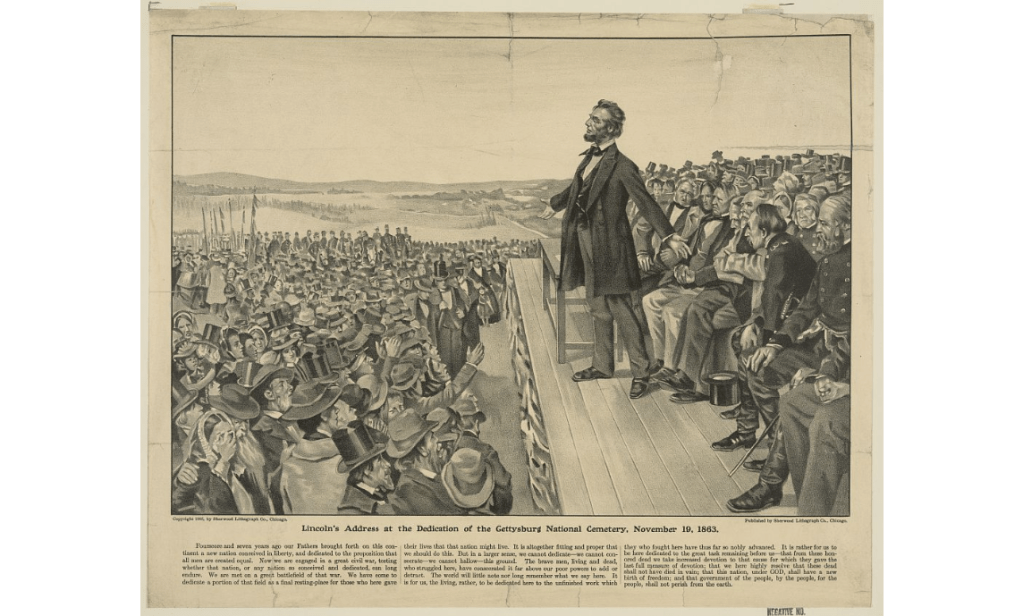
    Lincoln at Gettysburg from a lithograph by Sherwood Lith. Co., c. 1905 (Library of Congress)

                Tracing the rails from Baltimore to Gettysburg, Lincoln’s train rolled past station after station as it followed the afternoon sun to the west. On the platforms rested lines of neatly stacked empty coffins. Reflecting in the windows of the president’s car, they would have appeared to his gaze as grim reminders of the somber task that lay ahead. The purpose of the pine, poplar, and oak boxes was to collect the battlefield remains of loved ones destined to return home or to their eternal rest under the broad Pennsylvania skies.[1] Some newspaper accounts recorded that their numbers rivaled those of the crowds of riders on the B&O rail line who jostled one another to pay a premium for a seat to carry them to the dedication of the new national cemetery at Gettysburg.[2] There, on the next day, 19 November 1863, Lincoln was to address the gathered masses and media at a grand consecration ceremony. Accounts don’t reflect if the people arrived before the coffins, or if the coffins arrived first, but both would serve as witnesses to the war’s devastation at that place.[3]

                Along the way, the president’s journey broke several times for engine changes and to make necessary mechanical adjustments. But it was at Hanover Junction that the Reverend M. J. Alleman of St. Matthew’s Lutheran Church coaxed Mr. Lincoln from the train to offer a few words to the gathered crowd of cheering locals. These words drew the president forth: “Father Abraham, come out, your children want to hear you.”[4] The biblical imagery (Genesis 17:5) was intentional and not lost in the moment, as Lincoln was the patriarch of his people, and resolute in his faith. The president obliged the reverend, and after exchanging a few brief pleasantries that seemed to please the upturned faces of the smiling crowd, was on his way again.

                Several years earlier in June 1858, in his acceptance address for the Illinois Republican Party Senate nomination, Lincoln underscored his stance on the state of slavery in the nation with the words found in Mark 3:24-25, “If a house is divided against itself, that house will not be able to stand.” From the time of that pronouncement through the remainder of his presidency, he relied on scripture to provide structure and meaning to his thoughts. As he had once noted, the Bible was the “best gift God has given to man.”[5] In truth, it was a book that was highly revered by most of the nation at the time. Subsequently, Lincoln had issued Proclamation 85 on 12 August 1861 and Proclamation 97 on 30 March 1863, both calling for national days of fasting, prayer and humiliation. They were meant to be times of reflection and repentance and an admonition that the “awful calamity of civil war which now desolates the land may be but a punishment inflicted on us for our presumptuous sins.”[6] Regardless of the nation’s earnest petitions, however, between that March and his arrival at Gettysburg in November, an additional 15,000 blue and grey lives had been lost in the bloody contest between the North and South.[7] The weight of that knowledge must have pressed heavily on Lincoln.

                Arriving at Gettysburg in the late afternoon, Lincoln traveled by carriage from the station to the home of local attorney David Wills, who hosted him for the evening.[8] That night, the president suffered the burden of his thoughts, concerned for the state of the nation and distracted by the health of his dear son Taddie, who lay bedridden back in Washington still in recovery from a case of typhoid fever.[9] It was against this backdrop that some scholars suggest Lincoln scripted his comments for the next day.[10] The president awoke on the 19th to a day that was clear and bright, and at 52 degrees was quite mild for the season. Later that morning, at ten o’clock, with his long frock coat flapping in the breeze, Lincoln, together with his aides, followed in procession behind the ceremony’s Chief Marshal and his officers. They were in the lead of hundreds of participants, including representatives of several federal departments, various members of Congress, bearers with the flags of the states, committees of different religious bodies, representatives of the Soldiers’ Relief Association, the Knights Templar, and the Odd Fellows, a local Masonic fraternity, assorted fire companies, scores of citizens from several northern states, and members of the press corps.[11] Witnessing it all were the families of the participants, the citizens of Gettysburg, and hundreds of wounded Union soldiers still in recovery. Sprinkled in among the last group were also handfuls of wounded Confederate prisoners, left behind when their army withdrew to the south after the battle. From the town square, the procession moved south along Baltimore Street, turning onto the Emmittsburg Road, then onto the Taneytown Road, eventually arriving at the designated site on Cemetery Hill just south of the town, a total distance of approximately three quarters of a mile.

                The dedication ceremony began with a musical prelude of “Old Hundredth” played by the U.S. Marine Band.[12] Following this was a brief invocation by the Reverend T.H. Stockton, who appealed to Heaven to bring comfort to the bereaved families as well as to the sick and wounded soldiers.[13] A second musical interlude consisting of the hymn “Consecration Chant” sung by the Baltimore Glee Club followed. The president, however, would not be the first to speak after the reverend’s supplication, nor did the program list him as the keynote speaker. Edward Everett held that honor. Known nationally for his oratory skills and eloquence, Everett spoke for over two hours recounting the battle at Gettysburg, the glorious Union victory, and the sacrifices made by the soldiers.[14] After a brief pause to allow for applause and murmurings of approval, another brief musical interlude followed. At its conclusion, Lincoln rose to speak. In comparison with that of his predecessor, the president’s presentation may have initially appeared too perfunctory. Still, in only 272 words, Lincoln was able to capture the mood of the nation and the spirit of the time.[15] But, as history notes, it was only an uneasy silence from the nonplussed audience that hung in the air after his final words. Eventually, a hesitant but polite applause began to ripple through the crowd as the president retired from the podium. Immediately afterward, a choir performed “Dirge,” a short composition by Alfred Delaney.

                Perhaps Lincoln’s delivery was less than the audience expected, particularly after enduring the assault of Everett’s cascading oration. Or perhaps Lincoln’s words carried the weight of deeper meaning that took time to register in the hearts and minds of those who heard them. Nevertheless, Everett kindly wrote Lincoln days afterward, saying, “I should be glad if I could flatter myself that I came as near to the central idea of the occasion, in two hours, as you did in two minutes.”[16] To this, the president graciously replied, “I am pleased to know that, in your judgment, the little I did say was not entirely a failure.”[17]

                The text of Lincoln’s address is noteworthy and remains etched in history. Since the day of its proclamation, it has continued to gain in significance as an emblem of Lincoln’s legacy of compassionate leadership and his commitment to maintaining a spiritual foundation for the wounded nation. Woven throughout its text are meaningful allusions to scripture. Lincoln made this apparent from the opening phrase, “Four score and seven years ago…,” which follows a descriptive style that echoes the words of both Psalm 90 and the Book of Esther 1:4. Throughout his narrative he offered hope for the rebirth of the nation from the ashes of a destructive war to a reunification of the broken halves and from the sacrifices of the “honored dead” to the task of the living who must dedicate themselves to the “unfinished work” of healing. He continued on to charge that the dead “shall not have died in vain” and their ultimate sacrifice, like that of the Messiah, will bring a “new birth of freedom,” an eternally Christian-centered message. All of this, as he noted simply, is to be “under God.” Scholars recognize these connections and remind us of the reliance of Lincoln and the country on His eternal mercy as the dark clouds of war hung low over the bleeding nation. In this, we recognize Lincoln’s humility (Proverbs 18:12, 15:33, 22:4) and his contrite heart (Psalm 51:17) that encourages us also in our darkest hours to seek out and rely on God’s grace and mercy.


    [1] The intention was to inter only the bodies of the fallen Union troops at the new cemetery. Confederate dead lay in shallow graves where they had fallen in woods or fields scattered across the Gettysburg landscape.

    [2] This was the same rail line that would carry the president home to Illinois after his death.

    [3] The battle resulted in a combined number of over 7,000 deaths from both armies. See American Battlefield Trust, https://www.battlefields.org/learn/civil-war/battles/gettysburg, accessed 5 March 2025.

    [4] William Anthony’s 1945 book, Anthony’s History of the Battle of Hanover, 50. See same at https://npshistory.com/series/symposia/gettysburg_seminars/15/essay3.pdf accessed 10 March 2025.

    [5] A.E. Elmore. Lincoln’s Gettysburg Address: Echoes of the Bible and Book of Common Prayer.    Carbondale: Southern University Press, 2009, 11.

    [6] The date he set was 30 April 1863. Proclamation 97, “Appointing a Day of National Humiliation, Fasting, and Prayer,” https://www.presidency.ucsb.edu/documents/proclamation-97-appointing-day-national-humiliation-fasting-and-prayer accessed 7 March 2025.

    [7] This includes the totals for the battles at Chancellorsville and Chickamauga. See American Battlefield Trust, https://www.battlefields.org/learn/civil-war/battles/chancellorsville and https://www.battlefields.org/learn/civil-war/battles/chickamauga, accessed 5 March 2025.

    [8] David Wills was a prominent local attorney who sat on the boards of several colleges and was instrumental in directing the recovery of the town in the aftermath of the battle, and in the establishment of the national cemetery.

    [9] Taddie was Thomas Lincoln, the fourth and youngest of the family’s sons. At the time of the Gettysburg Address he was ten years old. He died at the age of eighteen.

    [10] Others adhere to the popular story that Lincoln penned his famed address on the back of an envelope while aboard the train enroute to Gettysburg. Another tale adds that he borrowed a pencil from a young train engineer, Andrew Carnegie the future railroad magnate. That remains unsubstantiated. See Peatman, 83.

    [11] The official program for the day provides little detail other than listing these organizations in general.

    [12] “All People on Earth Do Dwell,” colloquially known as ‘Old Hundredth’ was one of the most popular hymn tunes of that time. It originated from Psalm 134 in the Second Edition of the Genevan Psalter. The current name derives from Psalm 100, thus the title. John Phillip Souza’s father was a member of the band, and as a nine-year old he was in attendance for the performance.

    [13] Stockton served as chaplain in the House of Representatives in 1859 and 1861, then as Chaplain of the U.S. Senate in 1862. 

    [14] Everett had served as the Governor of Massachusetts, US Senator from Massachusetts, US Minister to the United Kingdom, and the 16th President of Harvard University. He earned the nickname, “Ever-at-it,” a play on his name, for his typically long-winded oratories. In 1860, Everett had run against Lincoln on the Constitutional Union Party ticket together with Bell.

    [15] For the full text of the speech see, “Gettysburg Address Delivered at Gettysburg, PA,” Library of Congress, https://www.loc.gov/resource/rbpe.24404500/?st=text , accessed 11 April 2025.

    [16] Abraham Lincoln online, “Speeches and Writings,” https://www.abrahamlincolnonline.org/index.html , accessed 4 April 2025.

    [17] Ibid.
  • The Cristeros War

    January 13th, 2025
    St. Jose Sanchez Del Rio

    The Youngest Martyr

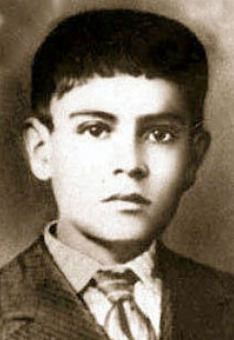
                As he gazed through the bars of his cold cell, Jose could see the dome of night stars above. They appeared as constant and bright as the faith in his heart. They gave him hope and provided comfort during this, the greatest trial of his young life. Although his guards taunted and beat Jose, he never felt alone; he knew that the Lord had sent angels to be by his side. He could feel their wings wrapped around him and hear the encouragement they whispered during the darkest moments. For days the government soldiers starved and scourged him, reviling him for his allegiance to his Christian faith. At times they offered respite if he would only deny it and the God of his people. But he, Jose, was no apostate; he was the smallest Cristero and proud to be chosen. Like Tarcisius, whose name he bore as an affectionate appellation from the older Cristeros, he would remain true.[1] It was in this way also that St. Paul counseled Timothy his own “true child in faith” (1 Timothy 2) that he should “Let no one have contempt for your youth, but set an example for those who believe, in speech, conduct, love, faith, and purity.” (1 Timothy 4:12). Finally, on 10 February 1928, his tormentors, tired of the games they played, took Jose from his cell. They slashed the soles of his feet, so his walking would be in agony, and marched him a long distance to the place of his execution. Along the way he prayed for his captors, recited the rosary, raised his voice in praise to Our Lady of Guadalupe, and continued to proclaim his steadfastness.[2] On the outskirts of Sahuayo, the place of his birth, Jose Sanchez Del Rio died by firing squad, accepting a martyr’s death at the age of 14.

    A Foundation of Faith

                For generations the people of Sahuayo had placed their faith at the center of their lives. It had been that way since Francisco Coronado had arrived and the first black-robed fathers had traveled to the surrounding hills and planted their crosses there.[3] Then, when the Parroquia del Sagrado Corazon de Jesus took form and shape in the center of the small but growing town the people at last had a visible anchor and touchstone for their faith.[4] Through all that collective history the fathers had come to serve as their shepherds, guiding and protecting the people of Sahuayo from the evils of the world and from the oppressive authorities who demanded much but provided little to the farmers and laborers. For approximately 120 years, a carousel of Mexican elites, politicians, generals, and landowners, had come and gone, vying to wrest power from one another while steering the masses forward toward their personalized vision of a modernized state. In doing so, they had clung to a secular idealism that offered selective suffrage and land reforms but eschewed religion and faith. For them, the Church had become a gadfly and an obstacle, an obsolescent governor that slowed the forward movement of the modernizing impulse. The elites associated it with the lower masses, those who became disposable and had no place in the march toward a newer Mexico. So it had been, through the tempests that grew between the church and state in the early 1800s, then through the failed reconciliations and broken reforms of 1857, 1867, and 1876, and on into the early twentieth century. Powerful leaders such as the wealthy landowner José Venustiano Carranza and later the atheist Plutarco Elias Calles eventually emerged and each in turn assumed the Presidency while taking steps to strip the clergy of its agency and power.[5] This included the seizure of church property, the closing of religious schools, the prohibition of monastic vows and religious order, and the exile and execution of priests. In February 1917, during the Mexican Revolution, Carranza and his supporters had encouraged the framing of a national Constitution and its oppressive Article 130 that underscored the concept of separation of church and state by restricting the legal status of the religious body. Continuing to fear the influence of the Church among the masses, the Constitutionalists also sought to curtail its power by permitting local legislators to limit the number of clergy. Some regional leaders, such as the governor of Jalisco, acted on that initiative and forced the clergy there to register with the Ministry of the Interior. Others followed suit, and eventually by 1934 only 334 priests remained to serve 15 million people throughout Mexico.[6]

    The Uprising

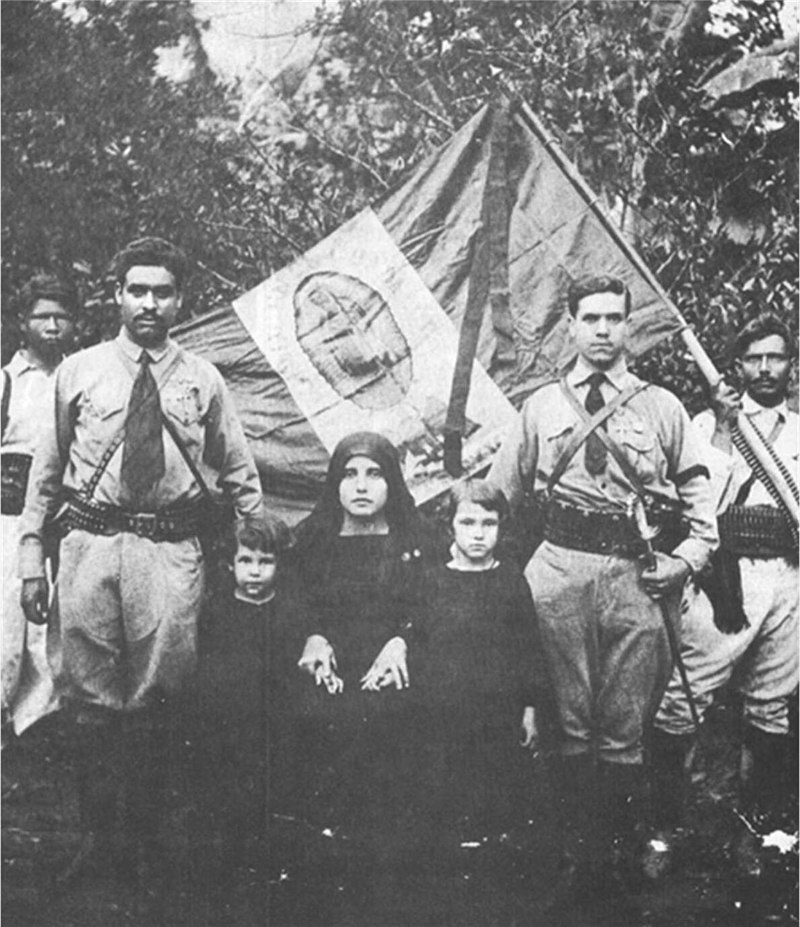
                Through that long arc of time, the masses of the country, particularly those in the more rural areas, tired of the inconsistency and oppression of Mexico’s elite leadership. They saw in those actions nothing less than the existence of a social and cultural dissonance that marginalized them. In the Church however, the people recognized a foundation that was their bedrock. Their faith in God remained constant and any suppression was not to be borne. Those of them who spoke up earlier had won the sobriquet ‘religioneros’ a title that the leaders in the Mexican capital eventually replaced with the term ‘Cristeros’ for the central place that Christ had in the lives of the rebels. Beginning in 1926 the Cristeros organized into brigades in the western states of Jalisco, Michoacán, Guanajuato, Aguascalientes, and Zacatecas where they fought back against their oppressors and the voices of anti-clericalism. By 1929 they had fielded approximately 50,000 rebels.[7] During their struggle, they meditated on the widow’s mite in sympathy for the poor who bore the burden of unfair taxation (Mark 12:43-44), they railed against the wealthy who failed to help the poor as did St. James (James 5: 1-8), and courageously challenged the tyrannical leaders who denied them the freedom of worship as did Daniel (Daniel 6:14-18). Until 1926 they demonstrated their resolve by engaging in open clashes with government forces. With the air echoing their battle cry, Viva Cristo Rey, they rushed into battle. Not always successful, they continued their operations for those three years, celebrating their victories but often melting away into the hills when facing overwhelming numbers. It was during one of these withdrawals that government forces captured Jose who was then serving as flag bearer for his troop. His imprisonment and torture followed. But Jose was not the only Cristeros to become a martyr. The list was extensive, amounting to 30,000 killed in defending their faith.[8] Often, the government would hang the bodies of Cristeros from telephone poles along roadways and railroads as examples to others.

    Cristeros leaders with families and their flag.

                During their war the Cristeros received spiritual support from Pope Pious XI who on 18 November 1926 issued the encyclical Iniquis Afflictisque “On the Persecution of the Church in Mexico.” In that document he condemned the government officials who “have ordered and are continuing up to the present hour a cruel persecution against their own brethren.”[9] Support also came from the Americans in the form of aid, food, and supplies from religious groups, and some arms from sympathetic organizations. The location of the United States also presented itself as a safe refuge for Mexicans who managed to cross the border to flee the fighting that continued with no end in sight. At long last however, the American government offered support to the Mexican government in the hopes of bringing stability to the region through a quicker end to the conflict, and with the expectation of gaining oil concessions that might resolve an expected shortage in the States.[10]

                The fighting came to an end through the focused efforts of the American ambassador, Dwight Morrow, who brokered an agreement between the Cristeros and the Mexico government. Although concessions in the settlement between the two sides ultimately denied the Church any political power and influence, most of its property previously confiscated returned to its control, and it was again able to resume religious training. The Mexican government also curtailed the persecution of priests and religious leaders. From a secular perspective the powerful influence of the Christian church over the lives of the masses was broken and the rebels a mollified, but for the Cristeros it was a hard won victory. The Church was finally out from under the heel of oppression and their faith had endured another period of persecution not unlike that of the Christians living in the shadow of the Roman Empire. Regardless of the outcome, some Cristeros, angered because the government had not invited them to the cease-fire negotiations, continued their resistance. However, within a few short years it had all ended leaving the Cristeros with the understanding that they had saved the faith for their county.

                Together with many others, Jose’s heroic act of faith as the youngest Cristero drew wide recognition.[11] The Catholic Church initiated the process for his canonization in 1996 recognizing him as a faithful servant. The process concluded in 2016 with his elevation to sainthood. His remains rest in the Church of Saint James the Apostle in Sahuayo, his hometown. The Cristeros’ stalwartness during time of duress, as exemplified by Saint Jose Del Rio, preserved the faith. His actions bring to mind the words of James 1:12, “Blessed is the one who perseveres under trial, because having stood the test, that person will receive the crown of life that the Lord has promised to those who love him.” 


    [1] Tarcisius was a twelve-year-old acolyte who died at the hands of a group of non-Christians during the persecutions of the Roman Emperor Valerian in the Third century.

    [2] Our Lady of Guadalupe, also known as the Virgin of Guadalupe, appeared in four visions of Mary to a Mexican peasant named Juan Diego in 1531. The faithful consider her the “Queen of Mexico” and “Patroness of the Americas.” An attempt to destroy a painting of the Lady by an anti-cleric fanatic in 1921 failed in its purpose but encouraged the Cristeros.

    [3] Francisco Vazquez de Coronado (1510-1555) explored the American southwest and areas of Mexico between 1540 and 1542.

    [4] Church of the Sacred Heart of Jesus.

    [5] Venustiano Carranza was a landowner and politician who served as president 1917-1920. Plutarco Elias Calles was a politician and general who served as president 1924-1928. He founded the Institutional Revolutionary Party (IRP) and controlled the government even after his presidency until 1934.

    [6] So effective was this strategy that by 1934 only 334 priests remained to serve 15 million people. See, Brian Van Hove, S.J. Baltimore’s Archbishop Michael Joseph Curley, Oklahoma’s Bishop Francis Clement Kelley and the Mexican Affair: 1934-1936, The Summer 1994 issue of “Faith & Reason.”

    [7] James T. Murphy, Saints and Sinners in the Cristeros War (San Francisco: Ignatius Press, 2019): 89.

    [8] Julia G. Young, Mexican Exodus: Emigrants, Exiles, and Refugees of the Cristero War (New York: Oxford University Press, 2015): 55.

    [9] Encyclical of Pope Pius XI on the Persecution of the Church in Mexico to the Venerable Brethren, the Patriarchs, Primates, Archbishops, Bishops, and other Ordinaries in Peace and Communion with the Apostolic See, accessed 9 January 2024, https://www.vatican.va/content/pius-xi/en/encyclicals/documents/hf_p-xi_enc_18111926_iniquis-afflictisque.html  

    [10] Oil shortages in the US in the early 1920s led to a panic that domestic supplies were running low. Thus the national leadership began casting about for alternative options.

    [11] Among the many who died were Father Miguel Pro, Jose Salvador Huertagutierrez a simple mechanic, Father Toribio Romo Gonzalez, and Maria de la Luz Camacho, a catechist. Since their deaths the Catholic Church has beatified or canonized each of these martyrs.

  • The Holy Spirit

    December 28th, 2024

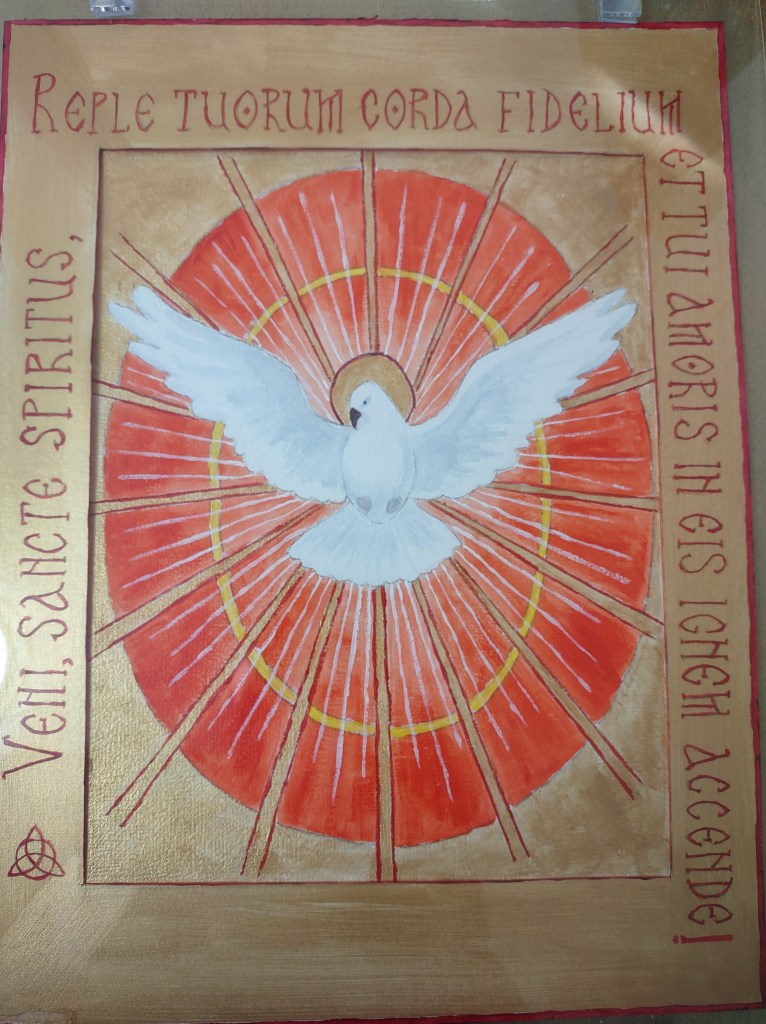
    During the Baptism of Jesus, the Apostle John saw the Spirit of God coming down from above like a dove (Matthew 3:16). While John was only able to baptize with water, Christ baptized with the power of the Holy Spirit. This picture depicts the Holy Spirit, which is one with the father and Son, descending to give us grace and lead us to God. The prayer framing the image proclaims, “Come Holy Spirit, fill the hearts of your faithful and kindle in them the fire of your love.”

    Original artwork by the author of this blog site, copyright 2024.

  • Newton’s Apple

    November 27th, 2024
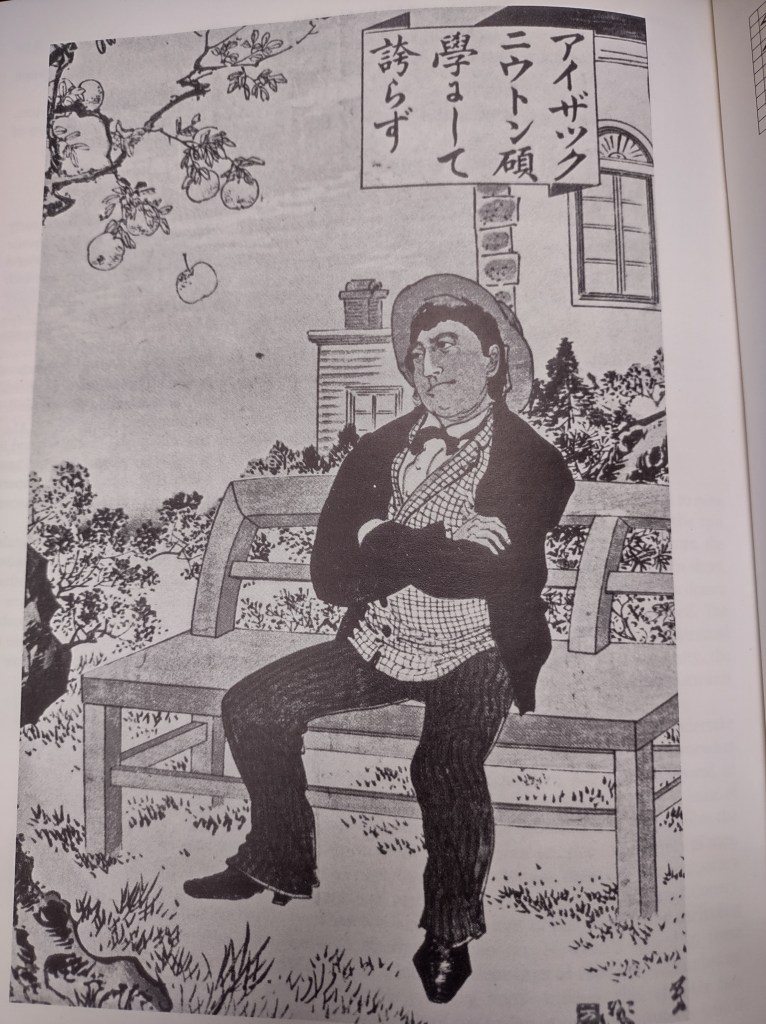
    “Isaac Newton, very great head of school but not pompous,” Japanese print, 1869

    Nature, and Nature’s Laws lay hid in Night.

    God said, Let Newton be! All was Light.

    Alexander Pope, Epitaph for Sir Isaac Newton (1735)[1]

                In a most profound way, Isaac Newton’s birth foreshadowed his life. It occurred on what an English novelist might describe as a perfect holly and ivy Christmas Day, in 1642, and because it was in Lincolnshire, England, the parish recorded it as a Julian date. Had it been a mere day’s voyage by ship to the east, on the Continent, it would have been on January 4th 1643, since the remainder of Europe had already adopted the changes made to the calendar proposed by Pope Gregory XIII.[2] Thus, one of the greatest minds of the Scientific Revolution measured his days according to two different rubrics of time. This was little different than the path of scientific discovery his life would travel as it coursed between secular and spiritual aspects. Both existed at the same time, each maintaining a seemingly different, yet parallel, character. Thus, the virtuosi of Newton’s day located themselves in one camp or the other. This they based on the issue of whether science was indeed rational and could be divorced from the hand of God, or if the finger prints of God were discernable on the universal blueprint. It was Sir Francis Bacon who in his Advancement of Learning made the case for the widely accepted notion that men should keep God and science separate by stating they would do well to “not unwisely mingle or confound these learnings together.”[3] Heeding this, the learned community generally acquiesced, including that the Royal Society of the day, which never examined a scientific theorem through the lens of theology. A metaphor that scholars often cite to illustrate the two positions is the comparison between the Book of Nature and the Book of Scripture.[4] The former is essentially religious and philosophical and describes the relationship between religion and science. The latter, is the Bible that describes God’s imperative in nature. So that in the first we can learn more about God through nature, and in the second more about nature through God. Or, as St. Paul had noted in Romans 1:20, as a chastisement to idolaters, “For since the creation of the world God’s invisible qualities—his eternal power and divine nature—have been clearly seen, being understood from what has been made, so that people are without excuse.”

                Among the day’s illuminati Newton positioned himself with a foot in each camp. Celebrated for his many achievements in chemistry, astronomy, optics, and mathematics, he might have found it tempting, even rewarding, to maintain allegiance to the scientific purists, but he did not. Evidence reveals a man whose personal nature never forsook the spiritual aspect of his life that saw him join a commission to build fifty new churches in the London area, and pay from personal funds for the distribution of bibles to the poor. More to the point are his writings that clearly reveal a keen scientific mind that subscribed to a strong belief in God. Even before his great opus, Principia, Newton penned an intimate religious text in 1662 that was a confession of forty-nine sins committed before Whit Sunday of that year including “Not turning nearer to Thee for my affections. Not living according to my belief. Not loving Thee for Thyself.”[5] He was not a man who could easily divorce himself from the essence of spirituality even as he influenced scientific understanding. Though he never sought to draw attention to his theological beliefs, so as to avoid public controversy, he continued to write about them. Archives and collections contain his non-scientific works on Observations upon the Prophesies of Daniel, and the Apocalypse of St. John (1733), several works on church history, and a number of drafts of an Irenicum.[6] Important also as evidence in this regard was Four Letters from Sir Isaac Newton to Doctor Bentley, Containing Some Arguments in Proof of a Deity, published in 1756 nearly thirty years after his death.[7] In this collection he wrote to Bentley who was then serving as Master of Trinity College, Newton’s alma mater. In these missives it is clear that he saw design in the universe as a system requiring “a cause which understood and compared together the quantities of matter in the…Sun and planets and the gravitating powers resulting from thence.”[8] To Newton it was no coincidence that planetary motion and the orbits of comets were mere happenstance.

                Newton’s greatest admission of a Divine plan finally emerged in his seminal work, The Mathematical Principles of Natural Philosophy, colloquially known as his ‘Principia.’ Although the first of three editions (all in Latin) appeared in 1687, it was the 1713 version in the “General Scholium,” an appendix to the greater work, where he confessed his grand design stance.[9] Here it is, after three sections filled with his scientific findings, theorems, and propositions that Newton writes, “This most beautific [sic] system of the Sun, planets, and comets, could only proceed from the counsel and dominion of an intelligent and powerful being.” He continued, “This Being governs all things, not as the soul of the world, but as Lord over all; and on account of His dominion He is wont to be called Lord God…He is supreme, or most perfect…He is eternal and infinite, omnipotent and omniscient.”[10] Above all, His hand is in all and orchestrates all.

                The Scientific Revolution was a period of time beginning with Copernicus and concluding with Newton when men felt drawn by the gravitational pull of the classical sciences. For some, it offered the promise of a new ego-centric landscape where Man was the emergent master discovering the key to the mysteries of the universe, and where Nature was merely a mistress who Man could eventually manipulate and seduce to reveal her secrets. But Newton would not concede to the absence of God’s manifest influence. He truly believed that his own work was an extension of his faith and this drew him closer to knowing God, and that a further study of the sciences and nature could lead mankind to a closer relationship with the Supreme Being who was the architect of the universe. As the words of Psalm 111:2 tell us, “Great are the works of the Lord, studied by all who delight in them.” To those of great intellect during Newton’s time, who stood with hubris disparaging his claims, God’s words to a reproved Job seem appropriate, “Who is this that obscures divine plans with words of ignorance? (Job 38:2). A fuller admonition, which might have been leveled at Leibnitz, Darwin, or Bacon, follows:

    Where were you when I founded the earth? Tell me, if you have understanding.

    Who determined its size; do you know? Who stretched out the measuring line for it?

                Into what were its pedestals sunk, and who laid the cornerstone, while the morning stars sang in chorus and all the sons of God shouted for joy?

                And who shut within doors the sea, when it burst forth from the womb;

    When I made the clouds its garment and thick darkness its swaddling bands?

    When I set limits for it and fastened the bar of its door, and said: Thus far shall you come but no farther, and here shall your proud waves be stilled!

    Have you ever in your lifetime commanded the morning and shown the dawn its place for taking hold of the ends of the earth, till the wicked are shaken from its surface? (Job 38:4-13)

                So it was, like the apple that woke Adam and Eve to an awareness and knowledge that was the undoing of their innocence, an apple fell to earth in 1666 awakening Newton to consider the laws of gravity. The former caused Man to abrogate the natural laws of God, the latter reminded Man of God’s place in the laws of the natural. So it is, the apple offers a link between the two for Newton; understanding of the natural world and a desire to realize God’s hand in it. To this, Pope lauded Newton’s accomplishments in his epitaph.


    [1] Following his death in March 1727 Newton’s body lay in state in Westminster Abbey for three weeks. He is the first scientist to rest there in the Scientists’ Corner. The ashes of the famous theoretical physicist Steven Hawking rest between Newton and Charles Darwin.

    [2] Gregorian versus Julian calendars. The English eschewed following a ‘Papist’ calendar. England switched in 1752.

    [3] Frank E. Manuel. The Religion of Isaac Newton: The Fremantle Lectures 1973 (Oxford: Clarendon Press, 1974), 30. Although Bacon’s work appeared in 1605 it stated the case clearly in the Introduction that it was for the advancement of learning, both Divine and Human, and therein the two should remain separate. Many learned men held this belief through the following century.

    [4] For a more comprehensive explanation see Andrew Janiak, “The Book of Nature, The Book of Scripture,” The New Atlantis, no. 44, Winter 2015, 95–103.

    [5] Manuel, 15.

    [6] Irenicism promotes unity between Christian denominations and sects. Twelve editions of Observations upon the Prophesies of Daniel appeared in print between 1733 and 1922 attesting to public and scholarly interest in Newton’s theological perspectives.

    [7] Newton and the Reverend Doctor Richard Bentley exchanged letters between 1692 and 1693.

    [8] Fauvel, John, Raymond Flood, Michael Shortland, and Robin Wilson, eds. Let Newton be! (Oxford: Oxford University Press, 1988), 170. See also Four Letters from Sir Isaac Newton to Doctor Bentley, a bound collection of the letters from 1756, https://archive.org/details/bim_eighteenth-century_four-letters-from-sir-is_newton-sir-isaac_1756/mode/2up accessed 7 November 2024.

    [9] See William Whiston’s translation, https://isaacnewton.ca/wp-content/uploads/2013/06/newton-general-scholium-in-whiston-three-essays-1713-letter-size.pdf accessed 7 November 2024. The “General Scholium” appears at the end of the third book in the Principia prior to the section titled “The System of the World – A Grand Summary.”

    [10] See Andrew Motte’s translation of the “General Scholium,” to the Principia (1729), accessed 10 November 2024, https://isaacnewton.ca/wp-content/uploads/2013/06/newton-general-scholium-1729-english-text-by-motte-letter-size.pdf

  • The Sounds of Freedom

    January 20th, 2024

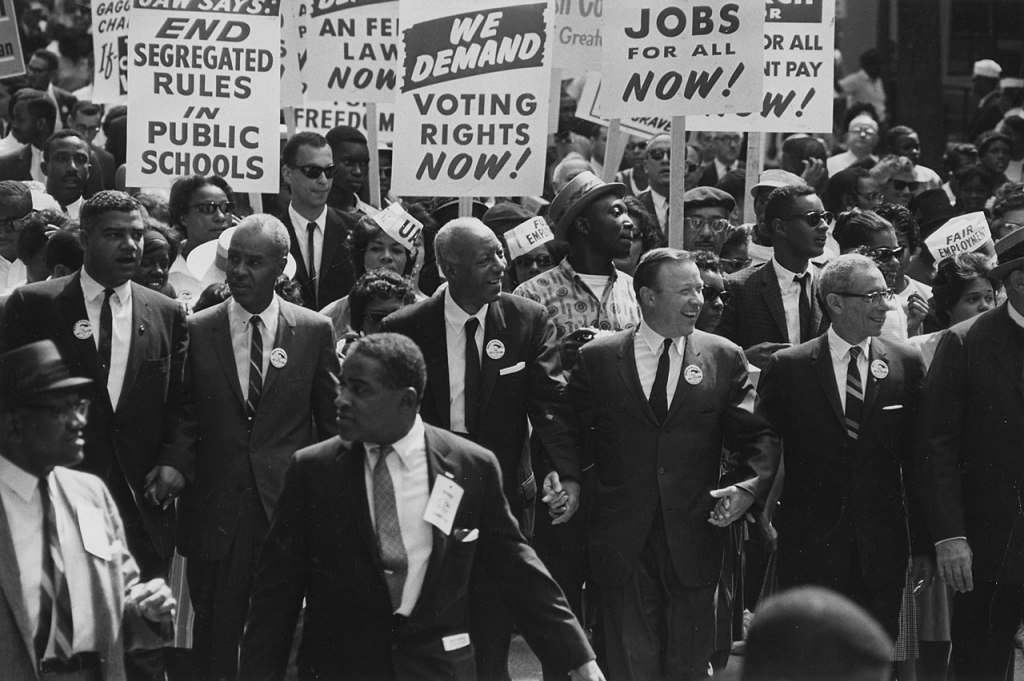
    Night after night, during the long, hot summers of the early postwar decades, television screens across the nation cast glowing black and white images of the evening news into the family rooms of America. Reflected in the eyes of viewers were scenes of Civil Rights marchers moving along in solemn files, usually taunted and jeered at by crowds who flung ugly oaths at them. Occasionally, a rapid movement would catch the eye as a hostile bystander, intending harm, would hurl an object at them. Those not fortunate enough to dodge the missile suffered the attack, but the marchers’ spirits never seemed to waver under the heat of the assault. Police and authorities often stood back letting the mob’s aggressions play out, or took actions of their own to interdict the marchers by deploying water cannons, gas, and snarling dogs. Still, as these dramas played out, the marchers continued on, moving inexorably through the towns, cities, and segregationist citadels of the American South where the long-held cultural consensus had so long denied them the liberties they sought. Place names like Birmingham, Washington, Little Rock, Atlanta, Montgomery, and Selma served as markers along the trail they journeyed, and so also became etched as scars into the national psyche.[1]  

    The march on Washington, DC, August 28, 1963.

     As they marched, they breathed words about freedom, justice, and the familiarity of suffering, and their songs rose high above them like prayers caught on the wind. The lyrics followed from Gospel verses that almost every man, woman, and child among them knew by heart. They were words that had echoed for centuries from church pulpits, lifting to the rafters, and settling upon the congregations. They were lyrics rooted in faith and hope, and anchored in Holy Scripture. It was the language of the American Civil Rights movement. By the 1950s, this music of faith had become the voice of that crusade. It made sense that it flowed from that foundation, the one place where enslaved and marginalized people could find refuge during their years of oppression. Songs such as “We Shall Not Be Moved” (Psalm 62:6) spoke of resolve, and “We Shall Overcome” (John 16:33) encouraged perseverance in the face of adversity. They emerged from scriptural passages, lifting souls up from despair and offering them hope, a hope that translated into the struggle for civil rights.

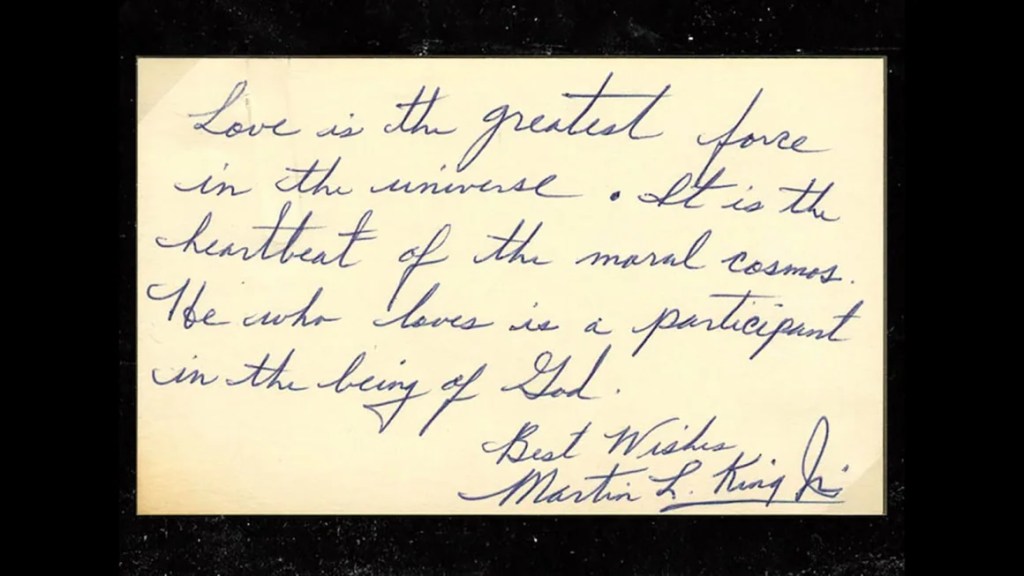
    The leadership of the movement too came from that same place, through the clergy. Among them were the Reverend Dr. Martin Luther King, Jr., Ministers Fred Shuttlesworth, Ralph Abernathy, C.T. Vivian, and others who spoke of the redemptive powers of forgiveness (Romans 5:10), love (1 Peter 4:8), and suffering (Romans 8:18). Addressing packed churches these men drew their inspiration and energy from the Bible, using it to encourage the formation of a grassroots movement that would carry their cause forward, but they also eschewed violence in its name.[2] As Scripture cautions against joining the wicked in drinking the “wine of violence” (Proverbs 4:17) and against its incessant pervasiveness in all actions (Isaiah 59:1-6), King preached that violence “is immoral because it thrives on hatred rather than love. It destroys community and makes brotherhood impossible.”[3] He also offered a foil against the violence and hatred directed at them by writing, “Love is the greatest force in the universe. It is the heartbeat of the moral cosmos. He who loves is a participant in the being of God.”[4] Those ideas have been his legacy, and were the heart and soul of the early struggle for civil rights in the United States during the first postwar decades.

    Those who teach and study history often fail to underscore the spiritual foundations of the incipient Civil Rights movement. The light of political and cultural turmoil of that day blinds many scholars to the reality of Scripture’s centrality to the cause. So, it is important to remember that it is in God’s word that we can always find encouragement to treat one another with justice and fairness. For Paul reminds us, as he had the Galatians, “There is neither Jew nor Greek, there is neither slave nor free person, there is not male and female; for you are all one in Christ Jesus.” (Galatians 3:28)

    Handwritten note by Martin Luther King, Jr. (circa mid-1960s).

    [1] Perhaps the best remembered march and gathering was at the Lincoln Memorial on August 28, 1963. It was the site of King’s famous “I Had a Dream” speech.

    [2] For more about how the Bible influenced and shaped the tenets of the early Civil Rights Movement see Richard Lischer, “In the Mirror of the Bible,” Chapter 8, The Preacher King: Martin Luther King, Jr. and the Word that Moved America (New York: Oxford University Press, 2020).

    [3] MLK’s Nobel Prize Lecture, “The Quest for Peace and Justice,” 11 December 1964, accessed 19 December 2024, https://www.nobelprize.org/prizes/peace/1964/king/lecture/.

    [4] Alicia Lee, “Martin Luther King Jr. Explains the Meaning of Love in Rare Handwritten Note,” CNN, 9 February 2020, accessed 19 December 2024, https://www.cnn.com/2020/02/09/us/martin-luther-king-jr-handwritten-note-for-sale-trnd/index.html.

  • Out of the Pit

    December 6th, 2023
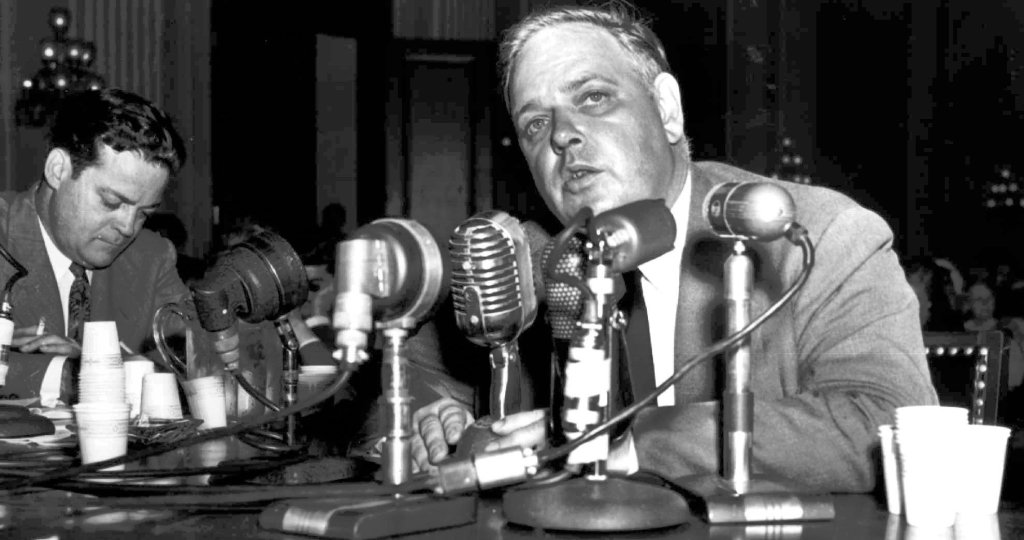
    Whittaker Chambers testifying before a House committee regarding Communist infiltration of the United States government.

                    Using the cloak of darkness to shield their escape, Whittaker Chambers spirited his family away from their home on Mount Royal Terrace in Baltimore to a lonely house set far back from the road in Pikesville. Although this secret refuge was only 7 miles distant, Chamber’s desperate gambit changed his life forever. It was April 1938 and he had just taken the first step in quitting his role as an espionage agent and breaking with the Communist Party. Fearful of the deadly retribution meted out to other defectors, he and his wife had taken cautious steps over the preceding months in planning their flight. When the moment seemed right they bolted, disappearing into the night in a lone automobile followed by a small moving van, winding their way northward on less trafficked back roads.

                    Chamber’s association with the Communist Party began years earlier in 1925. It came at a time when he seemed most lost. Coming from a dysfunctional home he never felt secure or happy. Then, when he learned of his brother’s suicide, he felt his life had no direction or purpose. Searching for answers he turned to the illusory promise of Communism feeling that it filled the void by offering him a faith and vision for his life, however hollow it might be. Embracing its ideologies Chambers joined the party and gave himself over to its cause. Between 1927 and 1929 he established himself in New York City as a noted writer and editor for the New Masses and the Daily Worker.[1] Later, finding a position in Washington, DC as a Communist labor organizer, he began work for the GRU as a courier.[2] Using connections he had made with sympathetic individuals in the US government, Chambers obtained a large number of classified documents.[3] Between 1932 and 1938, he carried these to New York where he delivered them into the hands of his Communist bosses. Gradually, however, he became disillusioned with the Party and its operations. He and his wife never agreed with the expectation that effective Communist espionage agents should be childless. With two of their own, they always felt marginalized among members of their network. Chambers also could not understand Joseph Stalin’s callous disregard for life as purges and disappearances of dissidents continued to sweep through the Soviet Union during the 1930s. Nor could he understand the Molotov-Ribbentrop Pact that bound the Soviets with Hitler’s Reich, their arch-enemy.[4] By 1938 he felt betrayed, lost, and once again without a moral compass. As Jonah had called out to the Lord so did Chambers. (Jonah 2:3) It was at this time that he made his decision to break free from the atheist Communist apparatus.

                    Years later, in his bestselling memoir titled Witness, Whittaker Chambers admitted that “two things made the break and flight possible…the devotion of my wife…the other was a faith that, if I turned away from evil and sought good, I would not fail.”[5] In that way, he followed the advice of Proverbs 3:5-7 that encourages us to follow the Lord’s path and turn from evil. Casting back into his past he reached out for a touchstone from his youth, the comfort of the church. His returning faith in the Lord would come to fill the dark void in his life with a renewed light. As he wrote, “At the end, all men simply pray…without exception, we pray…because there is nothing else to do, and because that is where God is – where there is nothing else.”[6] Through contemplation and prayer, and with the help of friends, he redeemed his life. He and his family eventually returned to their Quaker roots and began attending Pipe Creek Friends Meeting House in Maryland. (Philippians 4:6-7) Whittaker Chambers had at last emerged from the pit. (Psalm 40:1-3)

                    The chronicle of Whittaker Chambers’ life is a story of Cold War espionage and a world divided into geo-political spheres. It traces his association with known Communist operatives in key pre-war US government posts, and it follows him into the halls of Congress where he testified before panels about his participation in a Communist spy ring, and in headline-grabbing fashion exposed persons still involved in espionage.[7] Following his rejection of Communism he became a well-recognized writer who produced conservative, anti-communist think pieces for both Time magazine and the National Review. He later received recognition and deep appreciation from his nation for exposing the Communist infiltration of the American government.[8] But most importantly, his story is the narrative of a man who came to a cross-road in this life and made a pilgrimage that took him away from a dark soulless ideology back into the saving light of the one Lord, just as scripture describes to us the path we must follow in our journey to redemption and salvation. (Hebrews 11:16; the Pilgrimage Psalms 120-134) As Whittaker Chambers cautioned, “There has never been a society or a nation without God. But history is cluttered with the wreckage of nations that became indifferent to God, and died.”[9]


    [1] The New Masses was an American Marxist magazine that was in print from 1926 to 1948. The Daily Worker, founded by a collection of communists, socialists, and labor organizers, was a newspaper that served as one of the principle publications of the Communist Party of the United States (CPUSA), from 1924 to 1958.

    [2] The GRU (Glavnoye razvedyvatel’noye upravleniye) was the main intelligence directorate of the Soviet Army from 1918 to 1992.

    [3] Most of these individuals held posts in in the State Department, National Recovery Administration, Department of Labor, and the Department of the Treasury.

    [4] The Molotov-Ribbentrop Pact, properly titled the “Treaty of Non-Aggression,” was a treaty between the Soviet Union and the German Reich who signed it into agreement on 23 August 1939. It included discussion of the partitioning of Central and Eastern Europe to the advantage of each nation.

    [5] Whitaker Chambers, Witness (New York: Random House, 1952), 446. Chambers’ birth name was Jay Vivian Chambers, he later changed it to incorporate his mother’s maiden name (Laha Whittaker).

    [6] Witness, 446.

    [7] Among the individuals he exposed in 1948 was Alger Hiss, as well-respected official, who held a key position in the State Department. In combination with an investigation conducted by the House Un-American Activities Committee (HUAC) and hard evidence he provided, the government found Hiss and others to be guilty of espionage.

    [8] President Ronald Reagan recognized Chambers’ contribution by awarding him the Presidential Medal of Freedom, posthumously, in 1984.

    [9] Witness, 17.

  • The First Thanksgiving

    November 8th, 2023
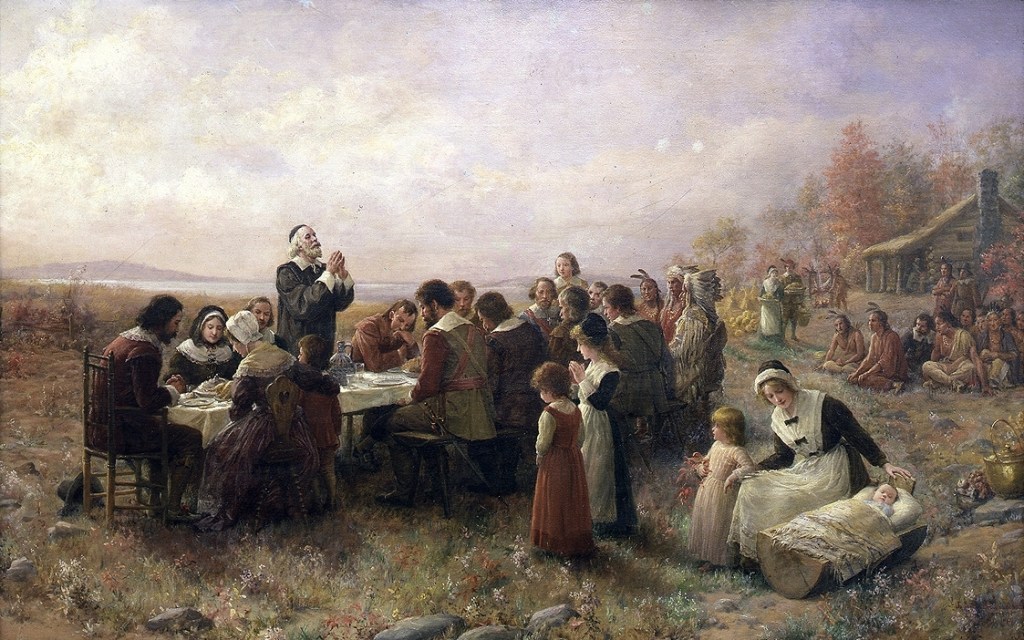
    The First Thanksgiving (1914) by Jennie Augusta Brownscombe

                The cool blue waters of the Atlantic gradually changed their color from a darker hue, then eventually to an earthy greenish brown as the ship’s prow arrowed its way up the James River. The three-month sea journey from England had at last run its course and the crew of the Margaret rooted her anchor to the soft river bed below. They were barely twenty miles north of the Jamestown settlement at a site named for one the organizers of their enterprise, Richard Berkeley. With hoary, cold-numbed fingers and hands the sailors worked to lower the last of the baggage, stores, and anxious passengers into waiting longboats. Putting their backs in it, the oarsmen pulled hard against the imperative of the river’s brown tidal waters. Minutes later, the nose of each craft ground against the sandy shore littered with stones, sticks, and clam shells. The 38 passengers stepped ashore into the chilled silence of a cathedral of trees. As a group, they knelt reverently, and with lowered heads listened to their leader, Captain John Woodlief, satisfy the first dictate of their company’s charter.[1] In a voice that pierced the stillness and echoed with the words from Psalm 69, he proclaimed, “We ordain that this day of our ship’s arrival, at the place assigned for plantation, in the land of Virginia, shall be yearly and perpetually kept holy as a day of Thanksgiving to Almighty God.”[2] Together they gave thanks for their safe journey and arrival in the new land and beseeched the Lord for successful and bountiful harvests in the years to come. The date was December 4, 1619, and it was the first recorded Thanksgiving celebration on American soil.

                Two years later, a second, better remembered, moment of Thanksgiving took place at Plymouth, Massachusetts in the autumn of 1621. There, the English settlers gathered with their Wampanoag neighbors to celebrate a good harvest, and to cement better relations between the groups. It would be this second celebration that became the stuff of historical legend and an inspiration for paintings, poems, and grade school pageants. But the two events, though separated by time and distance, testify to the praise and spiritual worship that was central to the early American identity. Often in endeavors such as these, the new arrivals paused to recognize the manifest grace of God that guided and protected them and provided for their needs. Just as those at the Berkeley Plantation had done, the settlers at Plymouth raised their voices to send thanks to their Heavenly Father for His “unspeakable mercy” and the provision of “meate and drinke for the nourishment of our weak bodies.”[3] It was in November of 1623 that the governor of the colony, William Bradford, proclaimed the 29th day of that month to be one of worship for all people “to render thanksgiving to the Almighty God for all His Blessings.”[4] This was as Chronicles advised, “Give praise to the Lord, proclaim His name; make known among the nations what He has done.” (1 Chronicles 16:8)

                Over the years there has been some controversy concerning the actual first Thanksgiving celebration. On November 9, 1962, Virginia State Senator John J. Wicker responded to John F. Kennedy’s 1962 Thanksgiving Proclamation by noting that the President had given full credit to the Pilgrims of Plymouth, and neglected to mention the earlier event in Virginia. An apology arrived, via historian Arthur Schlesinger, who agreed with Wicker and wryly placed the blame on the “unconquerable New England bias” within the White House.[5] Kennedy corrected the error the following year by mentioning both Virginia and Massachusetts in that proclamation and pronouncing that the colonists all “gave reverent thanks for their safety, for the health of their children, for the fertility of their fields, for the love which bound them together and for the faith which united them with their God.”[6] These proclamations have continued since September 1789 when President George Washington named Thursday, November 26th of that year to be “A Day of Publik Thanksgivin’.”[7] 

                Thanksgiving celebrations in America are an annual tradition that reminds us of our deep spiritual connections with the early founders of our nation and provides us with an opportunity to give thanks for the bounty and freedoms we continue to enjoy as we put our trust in God. As Paul wrote, “Give thanks in all circumstances; for God’s will for you in Christ Jesus.” (1 Thessalonians 5:18)


    [1] London Company was a Division of the Virginia Company. It gained its charter in 1606 by King James I as an enterprise to establish a colony in America as a wealth making venture for investors. The company listed a set of ten instructions for the settlers to execute upon their arrival. The first was to give thanks.

    [2] For additional insights to the Berkeley celebration see H. Graham Woodlief’s  “History of the First Thanksgiving,” Berkeley Plantation, accessed 4 November 2023, http://www.berkeleyplantation.com/first-thanksgiving.html

    [3] King’s Chapel Prayer, link. https://www.kingschapel.net/a-pilgrims-prayer/

    [4] “Governor Bradford’s First Thanksgiving Proclamation,” Apple Seeds, accessed 3 November 2023, https://www.appleseeds.org/thankgv6.htm

    [5] Schlesinger served as special advisor and historian to the Kennedy administration from 1961 to 1963. “History of the First Thanksgiving,” Berkeley Plantation, accessed 4 November 2023, 2023, http://www.berkeleyplantation.com/first-thanksgiving.html  

    [6] Kennedy 1963 Proclamation link. American Presidency Project, John F. Kennedy, Proclamation 3560 – Thanksgiving Day, 1963, accessed 4 November 2023, https://www.presidency.ucsb.edu/documents/proclamation-3560-thanksgiving-day-1963

    [7] “Congress Establishes Thanksgiving,” The Center for Legislative Archives, National Archives, accessed 6 November 2023, https://www.archives.gov/legislative/features/thanksgiving#:~:text=A%20few%20days%20later%2C%20President,celebrated%20under%20the%20new%20Constitution

  • 1914 Christmas Truce

    October 26th, 2023
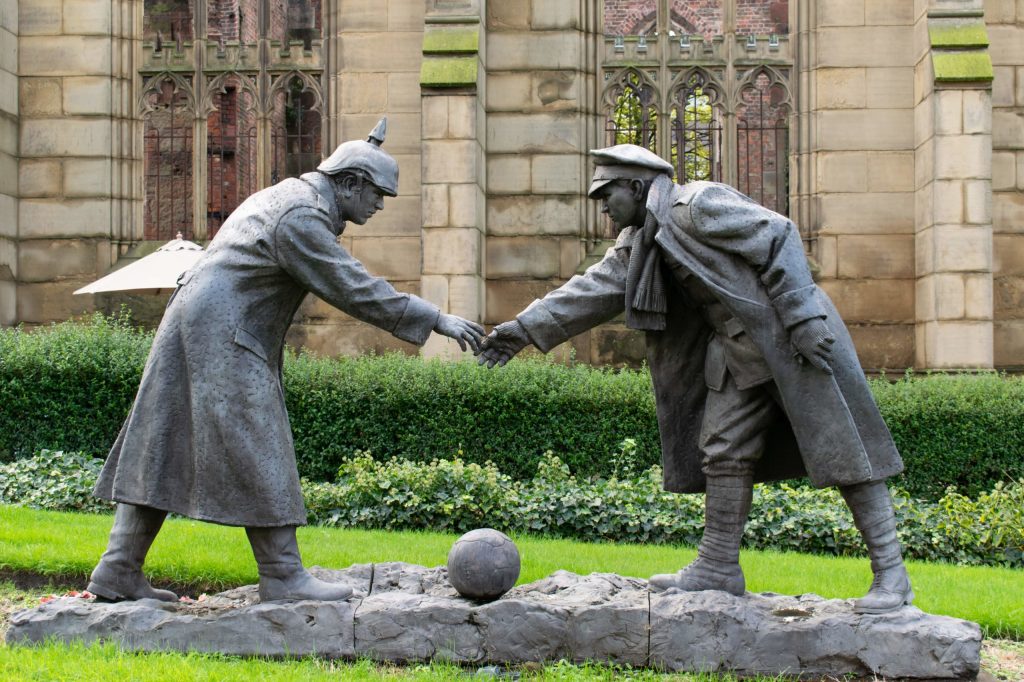
    The memorial statue titled All Together Now, located in Liverpool outside St. Luke’s church.

    Tender strains of Stille Nacht drifted across the open space of no-man’s land and British troops reacted by joining the chorus.[1] Mixed voices continued to blend in along sections of the trench line as men warmed themselves in the cold December night with memories of home and hearth. Across the way, small Christmas trees adorned with candles and mounted on parapets traced the line of German trenches. It was Christmas, 1914, and for a small space of time opposing armies drew themselves back from the brink of death to remember the birth of the Prince of Peace. For three days, December 24th to 26th, a surreal armistice appeared and quieted the darker impulses of Mars. By day, soldiers from each side wandered into the open spaces, shook the mud from their boots and approached an enemy they had only known from a distance. They helped one another identify dead comrades and recover their bodies. They took time to shake hands, exchange pleasantries and small gifts – things such as buttons, patches, tobacco, even bullets became the currency of good will. In time, scratch teams came together in convivial football matches. In a letter home one British soldier boasted that they had bested the Germans by a score of 1-0. For a moment in time, along a section of the front, there was a peaceful respite.[2] For many, thoughts of scriptures they heard on Sundays or as children must have given them the courage of faith to act as they did. (Romans 12:18 and Matthew 5: 43-45, live in peace with all.)

    Although never condoned by the upper levels of leadership some generals turned a blind eye to it when reports came in, others huffed with indignation over the fraternization and snorted hollow threats of courts-martials for treason.[3] Then they all tucked in their napkins and turned back to the lavish Christmas luncheons set before them far removed from the front lines.[4]

    As the three days of this brief Trêve de Noël drew to a close there was little doubt in the minds of the soldiers of both sides.[5] They knew that a coming dawn would usher in continued horrors and they would again demand the lives of an enemy with whom they had just celebrated Christmas day. Almost uniformly, letters home and personal diaries reflected the feelings that they all wanted the war to end, but they remained determined to fight on to a final victory. Still, for a short while, they were able to rise out of their grave-like trenches, watch the vapor of their own breath mingle with that of others, feel the warm grasp of another man’s hand, and see their own humanity reflected in the eyes of their enemy. (Malachi 2:10, conciliation before battle.)

    Today, several memorials dot the landscape where more than 100 years ago the mighty industrialized armies of World War One struggled to gain a precious few yards of earth. At Saint Yvon-Ploegsteert, Belgium, a small wooden cross stands like a diminutive roadside sentinel. Titled the ‘Khaki Chums Truce Cross’ it is a memorial to British comrades who lost their lives there, and to the time in 1914 that peace interrupted the killing. Further up the road, positioned adjacent to a small military cemetery, is the ‘Memorial to the Christmas Truce of 1914.’ It appears as an inverted artillery shell with an iron soccer ball mounted atop. Heaped around its base are various colored soccer balls left in tribute by visitors. Elsewhere, in the center of the town of Mesen, not far to the north of these memorials, is a statue that features a German and British soldier shaking hands as a small soccer ball rests on the ground between them. A duplicate, titled ‘All Together Now,’ stands outside Saint Luke’s church in Liverpool. It honors the memory of the Irish troops of the 10th Brigade, 4th Division, III Corps, who participated in the truce. (Matthew 5:9, blessed are the peacemakers.)


    [1] Stille Nacht is the German title of the popular Christmas carol “Silent Night.”

    [2] The section of the trench line extended from Wijtschate, Belgium (near Ypres) southward across the Lys River (Leie), then on to Neuve Chappelle, France, just under 20 miles total. In some places the British and German lines were only 25 yards apart. The British II, III and IV Corps had units participate, as did battalions of the Indian Corps. Opposite them were the German VII and XIX Corps and the 6th Bavarian Reserve Division. French units to the north and south of the Allied line did not participate.

    [3] Among those who protested the loudest was the II Corps Commander, General Horace Smith-Dorrien.

    [4] British Field Marshal John French provided a luxurious luncheon for his Corps commanders including Generals Haig and Smith-Dorrien. For a full description of the event see Terri Blom Crocker, “The Christmas Truce: Myth, Memory, and the First World War” (Lexington, KY: University Press of Kentucky, 2015).

    [5] For the French it was Trêve de Noël, for the Germans it was the Weihnachtsfrieden.

  • Joan of Arc

    October 16th, 2023
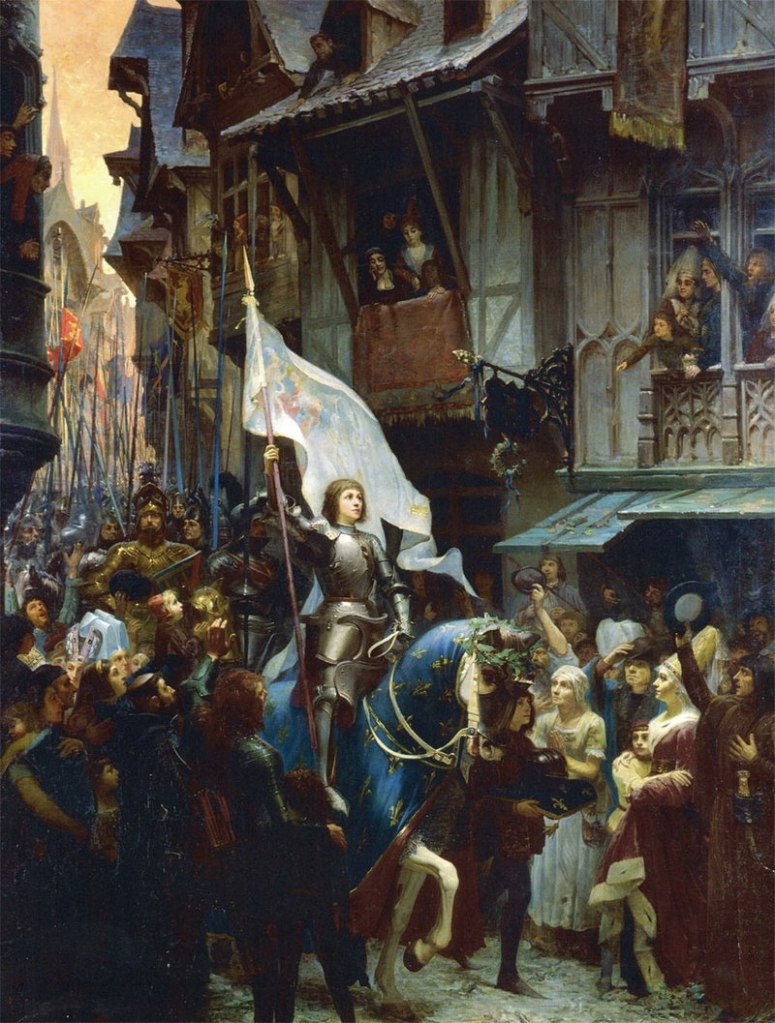
    Joan entering Orleans after its relief. A painting by Jean-Jacques Sherrer, 1887.

                According to her own testimony, saintly voices had whispered words of encouragement and guidance to Joan during those few short years she was the spiritual heart of France. From 1424 to 1429, she had heard them pressing a God-given mission on her to inspire the coronation of the Dauphin of France, Charles VII, and to lead his troops to victory in the Hundred Years’ War. Mounted on a charger, clad in shining armor, grasping a white standard, 16-year old Joan rallied the army to break the English siege of Orleans in April 1429.[1] As Moses had exhorted his people, so Joan rallied the French soldiers. (Exodus 14:5-14)  With faith in God, she showed no fear. (Psalm 27:3)

                In the light of her brilliant success during the Loire Campaign doubters melted away, and her popularity blossomed as did the nation’s morale. She had given the people hope in a time of desperation. Dubbed “The Maid,” by the masses who revered her, Joan fast become an icon of chivalrous heroism guided by the hand of God. Later that year, when French arms failed at the gates of Paris, and the Burgundians took her captive, dark forces conspired to prove Joan false.[2] She was brought before a tribunal chaired by the Bishop Pierre Cauchon, a patron of the English.[3] There, standing confidently against a barrage of questions designed to prove her collusion with the Devil, and her visions little more than hallucinations of a demonic mind, Joan’s responses reflected an unshakable faith in her cause. (Psalm 34:20-21) In a script that hardly veiled its predetermined intension, the tribunal found her guilty of heresy and handed her over to its executioners. On 30 May 1431, they burned Joan of Arc at the stake as she looked to the Heavens knowing she had triumphed in God’s cause. (Psalm 112:7-8)

                From an early age, Joan had shown a devotion to her faith. Witnesses from her village, Domrémy-la-Pucelle, attested to seeing her frequently in prayer.[4] They watched her adorn the saintly shrines with flowers on numerous occasions, and noted that whenever she “heard the bell for Mass, she came to church.”[5] They did not think it incomprehensible that at the age of 13 she could hear the voices of Saints Catherine and Margaret guiding and advising her to become France’s champion. Neither did her family and friends.

                Numerous authors have taken up their pens to offer interpretations of Joan’s life. Some, like the noted writer Mark Twain, have taken a “democratic” view that applauds her actions as those of a gallant soul leading a national struggle for independence from an oppressive church and king.[6] In this he takes an anti-clerical approach, offering a fictionalized character development of Joan ala Tom Sawyer and Huck Finn, removing her story from the spiritual and rendering it into a secular heroic narrative. Twain has little difficulty placing fanciful animist legends of woodland fairies on par with saintly visions, and demoting the village priest to a role as a dark despoiler of Joan’s innocent beliefs. In his version, the cleric attempts to convince her that a belief in fairies is a belief in the demonic.

                Other authors take a moderated approach, treating Joan as an individual with a deeply founded spiritual compass. Authors such as Andrew Lang offer this view of her actions in the context of a heroine who followed a path of divine guidance. In his account, Joan acted beyond the pale of common existence through an understanding that “the King of Heaven had chosen her to aid the King of France.”[7] Thus, her path became clear.

                Just fifteen years after her martyrdom, an investigation by the Catholic Church overturned the verdict of Beauvais and his puppets. In retribution for the wrongful condemnation and death of The Maid, Pope Calixtus IV excommunicated the Burgundian bishop posthumously. On 16 May 1920, Pope Benedict XV completed the canonization of Joan elevating her to the patron saint of France. Through the legend of Joan of Arc we can bear witness to a life given courage by faith in God, and the replenishment of confidence and trust in Him given to a people who had fallen into despair. (Isaiah 41:10)


    [1] The standard measured 3 feet by 12 feet. One side featured an image of Our Lord accompanied by the words Jhesus Maria, the other side bore an image of Our Lady with a shield bearing the arms of France. Both sides had images of fleur de leis and angels.

    [2] Burgundy had allied itself with the English with the hopes of gaining independence from France.

    [3] Cauchon served as Bishop of Beauvais from 1420 to 1432. He acted in ways to support English claims in France.

    [4] Her village stood approximately 20 miles to the southwest of the city of Nancy.

    [5] See Andrew Lang, “The Maid of France: Being the Story of the Life and Death of Jeanne D’Arc” (New York: Longman’s, Green, and Co., 1909), 37.

    [6] See Mark Twain, “Mark Twain’s Personal Recollection of Joan of Arc” (New York: Edwin Mellon Press, 1997). Twain published a fictionalized account of the events surrounding Joan of Arc as she was champion of France. He writes as if he were a personal friend and eyewitness to all that occurred in her life from her childhood until her death.

    [7] Lang, 41.

  • Arbeit fur den Herrn Macht Frei

    September 9th, 2023
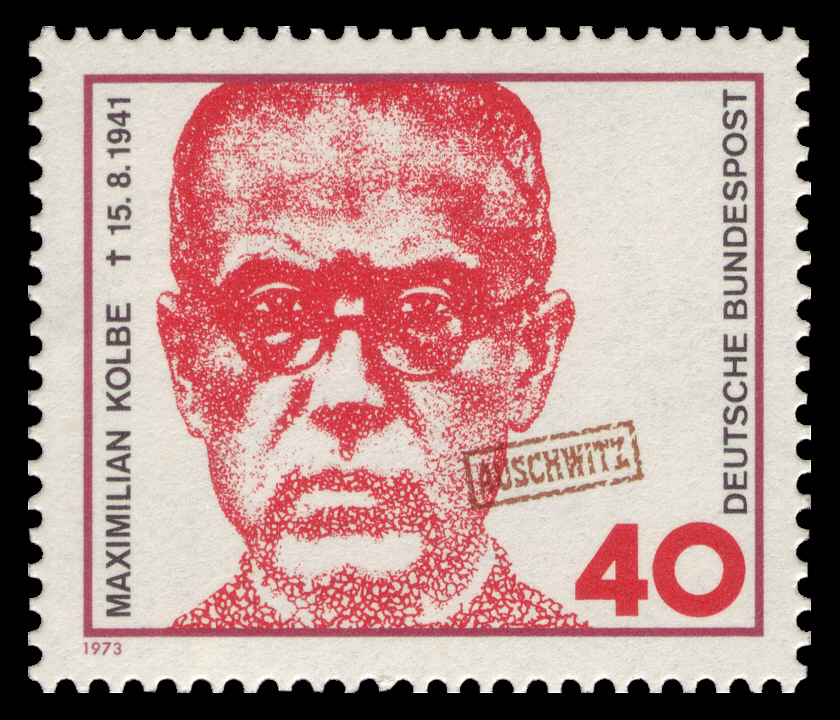
    German Postage stamp featuring the image of Father Maximilian Kolbe, 1973.

    Franciszek Gajowniczek understood what he was facing. Pulled from the line with nine other prisoners to die, the cold reality of his fate gripped him.[1] Thinking only of his family at that moment he cried out, “My wife! My children!” His lamentations gave voice to a desperate but futile protest. Just then, from within the larger group, a solitary figure pushed its way to the front. In a calm and sure voice a wraithlike man offered an unexpected exchange, his life for that of Franciszek’s. It might have seemed a strange occurrence, but this was the death camp at Auschwitz-Birkenau, and in the summer of 1941 extraordinary events were not uncommon.[2] Perhaps the SS guards saw it as an amusing diversion. After all, life in the camp was often full of such absurdities. The exchange occurred, and Father Maximilian Kolbe took the place of Franciszek Gajowniczek. The punishment the priest purchased that day with his life was death by starvation. In this brave and noble action Father Kolbe had fulfilled the words of John 15:13 that remind us, “Greater love has no one than this: to lay down one’s life for one’s friends.”[3]

                All ten prisoners that the guards selected found themselves sequestered in an underground bunker. Denied food and water their already weakened bodies deteriorated rapidly. According to a witness, every time the guards checked, they observed Kolbe encouraging the group with prayer. He refused to let them surrender their hope in the Lord or succumb to the thought that He was absent from their lives at that time, and so Kolbe continued to lead them spiritually to keep them from falling into despair. (Psalm 22) Nevertheless, the sentence levied by the Deputy Camp Commandant took little time to be effective. Just weeks after it began, only four men including Kolbe remained alive. Eventually, losing patience and anxious to bring the punishment to a conclusion, the Germans administered lethal injections of carbolic acid to the remaining few on 14 August 1941.

                Prior to his arrest and transport to Auschwitz, Father Maximilian Kolbe was no stranger to the Nazis. Before the war he had served as the guardian of the Franciscan monastery at Niepokalanów, a place he help found a decade earlier. After September 1939, when the Nazis occupied Poland, he refused to sign the Deutsche Volksliste, which would have granted him conditional immunity from persecution.[4] This was a clear rejection of all they stood for. Soon after, he and the other Franciscans in the monastery began clandestinely harboring Polish refugees and Jews.[5] During the same period, Kolbe continued to publish religious works, including a number that were critical of the Nazis. Never did he shirk his responsibilities, maintaining a constancy of faith knowing that in the Lord his labor was not in vain. (1 Corinthians 15:58) Eventually, unable to tolerate Kolbe’s actions any longer, the Germans shuttered the Niepokalanów monastery on 17 February 1941 and arrested him and several others. After a three month stay at Pawiak prison in Warsaw, they transported him to the camp at Auschwitz, where he found himself in a special barracks designated for priests and religious persons. There, the Nazis meted out harassment that included routine beatings. Regardless, Kolbe continued to serve as a priest fulfilling his duties as best possible, much to the ire of the SS guards. In July, he made the fateful decision that saved Gajowniczek’s life.

                Maximilian Kolbe’s sacrifice, bravery, and constancy of faith in the face of death offer inspiration to us all. Recognizing this, Pope John Paul II canonized him, and on 10 October 1982 declared him a Martyr of Charity. Today, a memorial statue of Father Kolbe stands adjacent to the Basilica Mniejsza on the grounds of the Niepokalanów friary.


    [1] An earlier escape attempt prompted the camp’s deputy commander, SS–Hauptsturmführer Karl Fritzsch, to select ten prisoners to pay the price with their lives as a warning against future endeavors.

    [2] Established in May 1940 the extermination and labor camp complex at Auschwitz-Birkenau, Poland alone accounted for the deaths of approximately one million Jews.

    [3] See also 1 John 3:16, https://www.vatican.va/archive/ENG0839/__P12D.HTM

    [4] The Deutsche Volksliste Category 1, Ethnically German. Despite his German ancestry, Kolbe refused to enroll and self-identify under this category. The listing was a device used by the Nazi Party to categorize inhabitants of the occupied territories. There was a total of four categories, with 2-4 retaining lesser privileges and liberties.

    [5] Approximately 2,000 Jews found refuge there during this time.

    Leave a comment Cancel reply

1 2
Next Page→

Blog at WordPress.com.


Loading Comments...
 

    • Subscribe Subscribed
      • History and the Word
      • Already have a WordPress.com account? Log in now.
      • History and the Word
      • Subscribe Subscribed
      • Sign up
      • Log in
      • Report this content
      • View site in Reader
      • Manage subscriptions
      • Collapse this bar