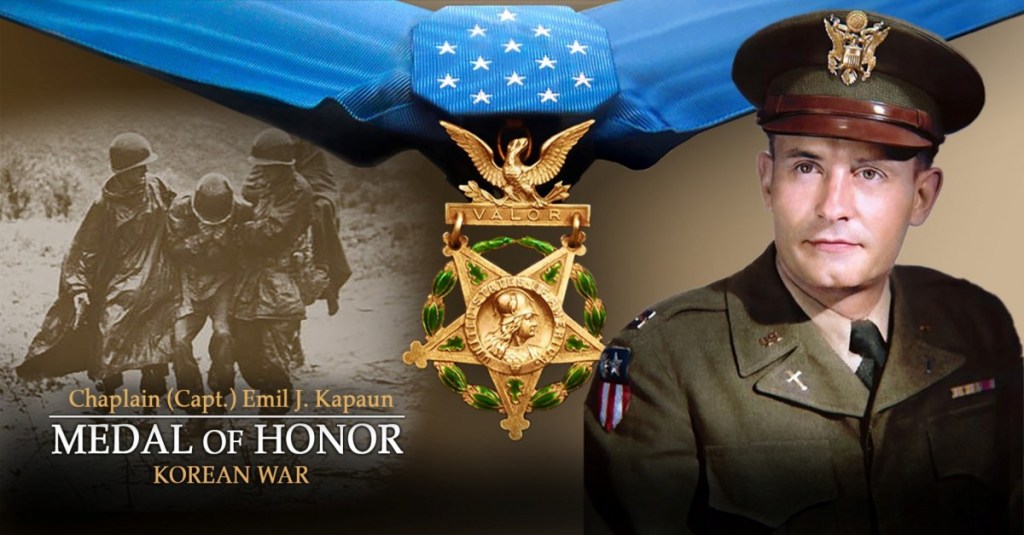
As late autumn arrives so do the frigid winds that blast out of the depths of Siberia coursing southward along the Korean peninsula. Many men have attested to the cold that drives like a knife through layers of clothing to rob the body of its essential warmth. In no time at all fingers and toes lose their feeling and consciousness becomes muddled in the slow embrace of hypothermia. In those conditions, under the steely grey November skies of 1950, the troopers of the US Army’s 3rd Battalion, 8th Cavalry Regiment found themselves locked in a desperate fight near the village of Unsan. With ammunition and food running low the unit was following orders to hold ground until the remainder of the regiment could exfiltrate from an attempted encirclement by superior forces of the Chinese People’s Volunteer Army. Over a period of two days casualties mounted as the Americans endured repeated human-wave assaults and engaged in hand to hand fighting.
As this action intensified, the battalion chaplain, Father (CPT) Emil Kapaun, made numerous forays beyond the safety of the defensive perimeter to retrieve the wounded. Despite having frozen feet he managed to save the lives of 40 troopers of the “War Horse” battalion.[1] Although members of the unit pleaded with him to join some others in making an escape, Father Kapaun refused to leave. He remained with them, bolstering morale, encouraging their faith, and ministering to the injured. Years afterward, the Army would posthumously award him the Medal of Honor for his actions during this fight. The citation reads, “Chaplain Kapaun calmly walked through withering enemy fire in order to provide comfort and medical aid to his comrades and rescue friendly wounded from no-man’s land.”[2] It also notes that as the enemy eventually overwhelmed the American forces Father Kapaun negotiated with a Chinese officer for a safe surrender for the survivors. Following this, “with complete disregard for his personal safety and unwavering resolve, [he] bravely pushed aside an enemy soldier preparing to execute Sergeant First Class Herbert A. Miller.”[3]
After their capture by the enemy, on 2 November 1950, Chaplain Kapaun and the remaining members of his unit found themselves in Prison Camp 5 at Pyoktong, North Korea. While interned there he would continue to serve. During his six months of imprisonment the chaplain continually circulated among the other prisoners encouraging them with words, nursing the sick and the injured as best he could under the circumstances, and scavenging food to supplement the men’s meager diets. After celebrating Mass on Easter Sunday in 1951, Chaplain Kapaun fell ill with pneumonia. He died shortly afterward, in isolation, on May 23rd of that year. A fellow prisoner testified that as his captors took him away he confided, “Don’t cry for me. I’m going to where I’d always wanted to go, when I get there, I’ll say a prayer for each of you.”[4]
Chaplain Kapaun served without fear, and his faith endured. Time and again he placed himself in perilous danger, confidently cloaked in the words of Psalm 23:4, “Even though I walk through the valley of the shadow of death, I fear no evil, for You are with me; Your rod and Your staff, they comfort me.” He drew strength also as Jesus preached “…do not be afraid of those who kill the body but cannot kill the soul; rather, be afraid of the one who can destroy both soul and body in Gehenna.” (Matthew: 10:28) The same fortitude that served him as a shield on the battlefield gave hope to those men trapped in the crucible of war with death as a near companion. They saw in Chaplain Kapaun the light of faith that Paul shared with the Romans, “…affliction produces endurance, and endurance, proven character, and proven character, hope, and hope does not disappoint, because the love of God has been poured out into our hearts through the Holy Spirit that has been given to us.” (Romans 5: 3-5) It was this enduring example of faith and hope in God that Father Kapaun gave as a gift to those around him.
Across the globe various memorials serve as testimony to Father Kapaun’s character and spirit. Military chapels in Korea, Germany, Bosnia, and Kansas carry his name, and monuments in Hawaii, Kansas, and at the Freedoms Foundation at Valley Forge, Pennsylvania reflect it as well. In 2015, an organization known as “Kapaun’s Men” formed with the purpose of encouraging others in their faith formation. But perhaps the greatest tribute came with the cause for sainthood that began when Pope John Paul II named him a Servant of God in 1993. This lengthy process continues today, and includes recovery of his remains in Korea that upon consideration could lead to his recognition as a martyr who died for his faith. If approved, the process for Father Kapaun’s beautification and eventual canonization would gain momentum. His was a life of fearless dedication to faith, an example to us all.
[1] US Army’s 3rd Battalion, 8th Cavalry Regiment has the nickname the ‘Warhorse Battalion.’ Their moto is ‘Honor and Courage.’
[2] President Barack Obama, “Medal of Honor Citation for Chaplain (Capt.) Emil J. Kapaun.” U.S. Army, https://www.army.mil/article/100859/medal_of_honor_citation_for_chaplain_capt_emil_j_kapaun, accessed 24 June 2023. The President made the presentation to a Kapaun family member on 11 April 2013.
[3] Ibid.
[4] Dan De Luce, “After 70 years, Pentagon identifies remains of Korean War Chaplain Who Received Medal of Honor,” NBC News online. https://www.nbcnews.com/news/military/after-70-years-pentagon-identifies-remains-korean-war-chaplain-who-n1259777 accessed 24 June 2023.
 History and the Word