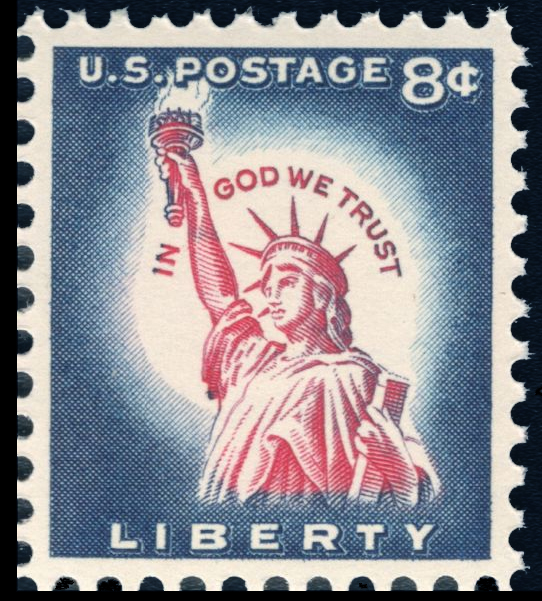
In the early years following the end of World War Two, triumphal banners fluttered high above the American landscape. The war was over, and America and her allies were victorious. Hearts swelled with a mix of pride, joy, and a sense of hope for the future. All too soon however, dark clouds began appearing on the horizon carried on a chill wind that threatened to cool the victorious fervor. Onetime allies had become geopolitical opponents, vying for the hearts and minds of people around the globe. In the clash of ideologies that followed in the early 1950s, a democratic West faced off against a communist East. Principals in this arena of conflict were the United States and the Soviet Union. Concerned that our message was not powerful enough, American elites pondered how to identify the ideals that best exemplified the nation’s character. In this effort, it was President Dwight Eisenhower who believed that the defining trait setting the United States apart from the Communists was a fundamental belief in God, as our “refuge and fortress.” (Psalm 91:2) That faith found its way into a bill introduced to the US Congress on February 8, 1954. It recrafted the Pledge of Allegiance to include the words “under God.”[1] That took effect on June 14, 1954 in a Joint Resolution of Congress that amended paragraph 4 of the 1942 Flag Code.[2] Addressing the change, Eisenhower commented, “From this day forward, the millions of our school children will daily proclaim in every city and town, every village and rural school house, the dedication of our nation and our people to the Almighty.”[3] That adoption to the pledge stood to make a distinction between the spiritual and religious foundations of the United States and the atheism of the Communists. But the American leadership did not rest there. Many on Capitol Hill still felt a need to further remind Americans and the world that a reliance on a higher power was central to the ideals of the United States. Consideration of a national motto that would reflect that came to their minds.
A number of historical examples foreshadow the acceptance of the phrase “In God We Trust” as the national motto. One historical account notes that it was a motto used by Benjamin Franklin’s Pennsylvania militia in 1748. Another locates the words in a variation of Psalm 115: 9-11, found in a 1785 Psalter used in both England and the United States. Another finds the phrase in the 1814 manuscript of Francis Scott Key’s poem Defense of Fort M’ Henry, “And this be our motto-In God is Our Trust.”[4] By 1864 the words appeared on the nation’s two-cent coin, as Union leaders sought a way to boost morale and steel the public’s resolve for a continued wartime effort. Eventually, that thread of usage wound its way to the halls of Congress in 1955. During those tense Cold War days, many political leaders felt that the current national motto, E Pluribus Unum, did not hold the same ideological currency as did the words “In God We Trust.” Others argued against change. Eventually, the Eisenhower administration applied political leverage and won the day. Through a joint resolution of the 84th US Congress (Public Law 84-140) the United States adopted its new motto on 30 July 1956 replacing E Pluribus Unum with “In God We Trust.” With that action, our national trust and reliance on the providence of God that Washington prayed for at Valley Forge, became evident to the world. In little time, the words began appearing on American currency, and in December 1962 artisans carved the words in marble above the rostrum of the Speaker of the House of Representatives.
Over the years, a number of cases have arrived in court with efforts to remove the newer motto as being contrary to the US Constitution, which clearly outlines the separation of church and state. In each instance however, such motions have failed. As Justice Sandra Day O’Connor ruled, “I believe that government can, in a discrete category of cases, acknowledge or refer to the divine without offending the Constitution.”[5] Similarly, in a 2001 case, plaintiffs argued to replace the Ohio State motto, “With God, All Things Are Possible,” a clear reference to the words in Matthew 19:26. Again, that effort failed with the court ruling that the Establishment Clause of the First Amendment does not forbid “generalized religious language in official discourse.”[6]
John Winthrop’s famous 1630 sermon proposing that America should be as like “City upon a Hill” wherein “The Lord will be our God, and delight to dwell among us, as his oune [sic] people” continues to echo from our nation’s past.[7] It set a precedent for the founders, and again for America and its leaders through the centuries, to turn our eyes to Heaven to seek guidance and protection from above. From the earliest days to today, belief in our motto, “In God We Trust,” stands as a testament to who we as a people can and should be. (Psalm 56:4)
[1] “Why Eisenhower Added ‘Under God’ to the Pledge of Allegiance during the Cold War,” History, accessed 14 August 2023, https://www.history.com/news/pledge-allegiance-under-god-schools .
[2] “United States Flag Code,” Wikipedia, accessed 14 August 2023, https://en.wikipedia.org/wiki/United_States_Flag_Code .
[3] “God in the White House,” American Experience, accessed 14 August 2023, https://www.pbs.org/wgbh/americanexperience/features/godinamerica-white-house/ .
[4] See full transcript at “History Resources: Defense of Fort McHenry,” Gilderman Institute, accessed 14 August 2023, https://www.gilderlehrman.org/history-resources/spotlight-primary-source/%E2%80%9Cdefence-fort-mchenry%E2%80%9D-or-%E2%80%9C-star-spangled-banner%E2%80%9D-1814 .
[5] Reference Elk Grove Unified School District v. Newdow (2004), accessed 14 August 2023, https://www.oyez.org/cases/2003/02-1624 .
[6] Reference American Civil Liberties Union of Ohio v. Capitol Square Review and Advisory Board (2001), accessed 14 August 2023, https://berkleycenter.georgetown.edu/cases/aclu-v-capitol-square-review-advisory-board .
[7] John Winthrop’s “City upon a Hill,” 1630, Gilderman Institute, accessed 14 August 2023, https://www.gilderlehrman.org/sites/default/files/inline-pdfs/Winthrop%27s%20City%20upon%20a%20Hill.pdf .
 History and the Word