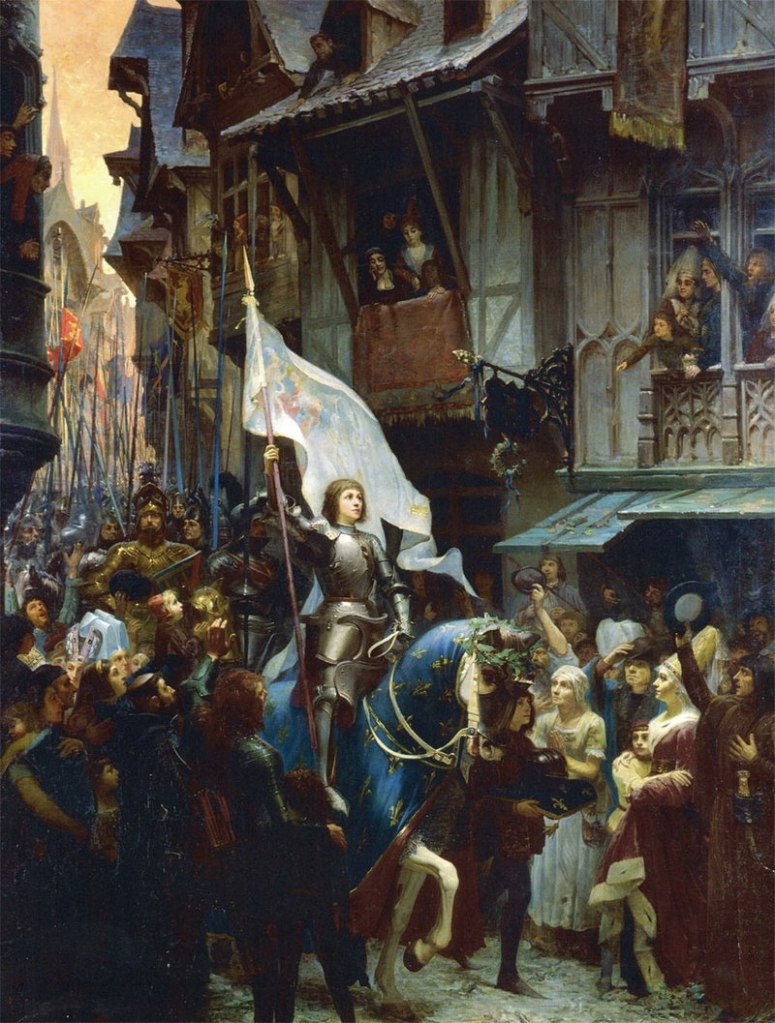
According to her own testimony, saintly voices had whispered words of encouragement and guidance to Joan during those few short years she was the spiritual heart of France. From 1424 to 1429, she had heard them pressing a God-given mission on her to inspire the coronation of the Dauphin of France, Charles VII, and to lead his troops to victory in the Hundred Years’ War. Mounted on a charger, clad in shining armor, grasping a white standard, 16-year old Joan rallied the army to break the English siege of Orleans in April 1429.[1] As Moses had exhorted his people, so Joan rallied the French soldiers. (Exodus 14:5-14) With faith in God, she showed no fear. (Psalm 27:3)
In the light of her brilliant success during the Loire Campaign doubters melted away, and her popularity blossomed as did the nation’s morale. She had given the people hope in a time of desperation. Dubbed “The Maid,” by the masses who revered her, Joan fast become an icon of chivalrous heroism guided by the hand of God. Later that year, when French arms failed at the gates of Paris, and the Burgundians took her captive, dark forces conspired to prove Joan false.[2] She was brought before a tribunal chaired by the Bishop Pierre Cauchon, a patron of the English.[3] There, standing confidently against a barrage of questions designed to prove her collusion with the Devil, and her visions little more than hallucinations of a demonic mind, Joan’s responses reflected an unshakable faith in her cause. (Psalm 34:20-21) In a script that hardly veiled its predetermined intension, the tribunal found her guilty of heresy and handed her over to its executioners. On 30 May 1431, they burned Joan of Arc at the stake as she looked to the Heavens knowing she had triumphed in God’s cause. (Psalm 112:7-8)
From an early age, Joan had shown a devotion to her faith. Witnesses from her village, Domrémy-la-Pucelle, attested to seeing her frequently in prayer.[4] They watched her adorn the saintly shrines with flowers on numerous occasions, and noted that whenever she “heard the bell for Mass, she came to church.”[5] They did not think it incomprehensible that at the age of 13 she could hear the voices of Saints Catherine and Margaret guiding and advising her to become France’s champion. Neither did her family and friends.
Numerous authors have taken up their pens to offer interpretations of Joan’s life. Some, like the noted writer Mark Twain, have taken a “democratic” view that applauds her actions as those of a gallant soul leading a national struggle for independence from an oppressive church and king.[6] In this he takes an anti-clerical approach, offering a fictionalized character development of Joan ala Tom Sawyer and Huck Finn, removing her story from the spiritual and rendering it into a secular heroic narrative. Twain has little difficulty placing fanciful animist legends of woodland fairies on par with saintly visions, and demoting the village priest to a role as a dark despoiler of Joan’s innocent beliefs. In his version, the cleric attempts to convince her that a belief in fairies is a belief in the demonic.
Other authors take a moderated approach, treating Joan as an individual with a deeply founded spiritual compass. Authors such as Andrew Lang offer this view of her actions in the context of a heroine who followed a path of divine guidance. In his account, Joan acted beyond the pale of common existence through an understanding that “the King of Heaven had chosen her to aid the King of France.”[7] Thus, her path became clear.
Just fifteen years after her martyrdom, an investigation by the Catholic Church overturned the verdict of Beauvais and his puppets. In retribution for the wrongful condemnation and death of The Maid, Pope Calixtus IV excommunicated the Burgundian bishop posthumously. On 16 May 1920, Pope Benedict XV completed the canonization of Joan elevating her to the patron saint of France. Through the legend of Joan of Arc we can bear witness to a life given courage by faith in God, and the replenishment of confidence and trust in Him given to a people who had fallen into despair. (Isaiah 41:10)
[1] The standard measured 3 feet by 12 feet. One side featured an image of Our Lord accompanied by the words Jhesus Maria, the other side bore an image of Our Lady with a shield bearing the arms of France. Both sides had images of fleur de leis and angels.
[2] Burgundy had allied itself with the English with the hopes of gaining independence from France.
[3] Cauchon served as Bishop of Beauvais from 1420 to 1432. He acted in ways to support English claims in France.
[4] Her village stood approximately 20 miles to the southwest of the city of Nancy.
[5] See Andrew Lang, “The Maid of France: Being the Story of the Life and Death of Jeanne D’Arc” (New York: Longman’s, Green, and Co., 1909), 37.
[6] See Mark Twain, “Mark Twain’s Personal Recollection of Joan of Arc” (New York: Edwin Mellon Press, 1997). Twain published a fictionalized account of the events surrounding Joan of Arc as she was champion of France. He writes as if he were a personal friend and eyewitness to all that occurred in her life from her childhood until her death.
[7] Lang, 41.
 History and the Word