Tender strains of Stille Nacht drifted across the open space of no-man’s land and British troops reacted by joining the chorus.[1] Mixed voices continued to blend in along sections of the trench line as men warmed themselves in the cold December night with memories of home and hearth. Across the way, small Christmas trees adorned with candles and mounted on parapets traced the line of German trenches. It was Christmas, 1914, and for a small space of time opposing armies drew themselves back from the brink of death to remember the birth of the Prince of Peace. For three days, December 24th to 26th, a surreal armistice appeared and quieted the darker impulses of Mars. By day, soldiers from each side wandered into the open spaces, shook the mud from their boots and approached an enemy they had only known from a distance. They helped one another identify dead comrades and recover their bodies. They took time to shake hands, exchange pleasantries and small gifts – things such as buttons, patches, tobacco, even bullets became the currency of good will. In time, scratch teams came together in convivial football matches. In a letter home one British soldier boasted that they had bested the Germans by a score of 1-0. For a moment in time, along a section of the front, there was a peaceful respite.[2] For many, thoughts of scriptures they heard on Sundays or as children must have given them the courage of faith to act as they did. (Romans 12:18 and Matthew 5: 43-45, live in peace with all.)
Although never condoned by the upper levels of leadership some generals turned a blind eye to it when reports came in, others huffed with indignation over the fraternization and snorted hollow threats of courts-martials for treason.[3] Then they all tucked in their napkins and turned back to the lavish Christmas luncheons set before them far removed from the front lines.[4]
As the three days of this brief Trêve de Noël drew to a close there was little doubt in the minds of the soldiers of both sides.[5] They knew that a coming dawn would usher in continued horrors and they would again demand the lives of an enemy with whom they had just celebrated Christmas day. Almost uniformly, letters home and personal diaries reflected the feelings that they all wanted the war to end, but they remained determined to fight on to a final victory. Still, for a short while, they were able to rise out of their grave-like trenches, watch the vapor of their own breath mingle with that of others, feel the warm grasp of another man’s hand, and see their own humanity reflected in the eyes of their enemy. (Malachi 2:10, conciliation before battle.)
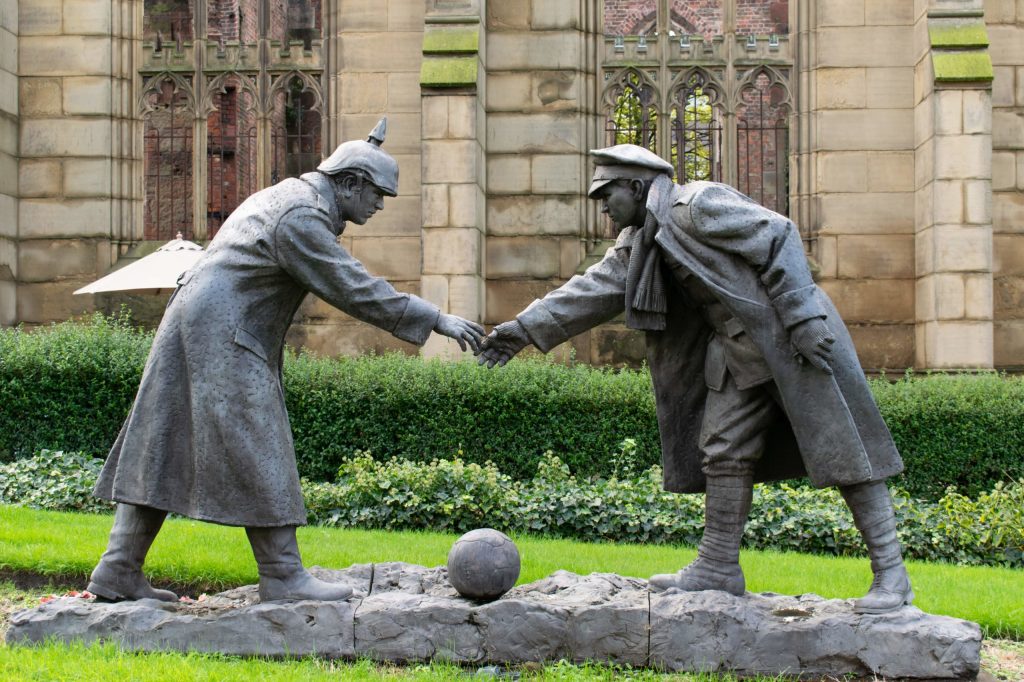
Today, several memorials dot the landscape where more than 100 years ago the mighty industrialized armies of World War One struggled to gain a precious few yards of earth. At Saint Yvon-Ploegsteert, Belgium, a small wooden cross stands like a diminutive roadside sentinel. Titled the ‘Khaki Chums Truce Cross’ it is a memorial to British comrades who lost their lives there, and to the time in 1914 that peace interrupted the killing. Further up the road, positioned adjacent to a small military cemetery, is the ‘Memorial to the Christmas Truce of 1914.’ It appears as an inverted artillery shell with an iron soccer ball mounted atop. Heaped around its base are various colored soccer balls left in tribute by visitors. Elsewhere, in the center of the town of Mesen, not far to the north of these memorials, is a statue that features a German and British soldier shaking hands as a small soccer ball rests on the ground between them. A duplicate, titled ‘All Together Now,’ stands outside Saint Luke’s church in Liverpool. It honors the memory of the Irish troops of the 10th Brigade, 4th Division, III Corps, who participated in the truce. (Matthew 5:9, blessed are the peacemakers.)
[1] Stille Nacht is the German title of the popular Christmas carol “Silent Night.”
[2] The section of the trench line extended from Wijtschate, Belgium (near Ypres) southward across the Lys River (Leie), then on to Neuve Chappelle, France, just under 20 miles total. In some places the British and German lines were only 25 yards apart. The British II, III and IV Corps had units participate, as did battalions of the Indian Corps. Opposite them were the German VII and XIX Corps and the 6th Bavarian Reserve Division. French units to the north and south of the Allied line did not participate.
[3] Among those who protested the loudest was the II Corps Commander, General Horace Smith-Dorrien.
[4] British Field Marshal John French provided a luxurious luncheon for his Corps commanders including Generals Haig and Smith-Dorrien. For a full description of the event see Terri Blom Crocker, “The Christmas Truce: Myth, Memory, and the First World War” (Lexington, KY: University Press of Kentucky, 2015).
[5] For the French it was Trêve de Noël, for the Germans it was the Weihnachtsfrieden.
 History and the Word