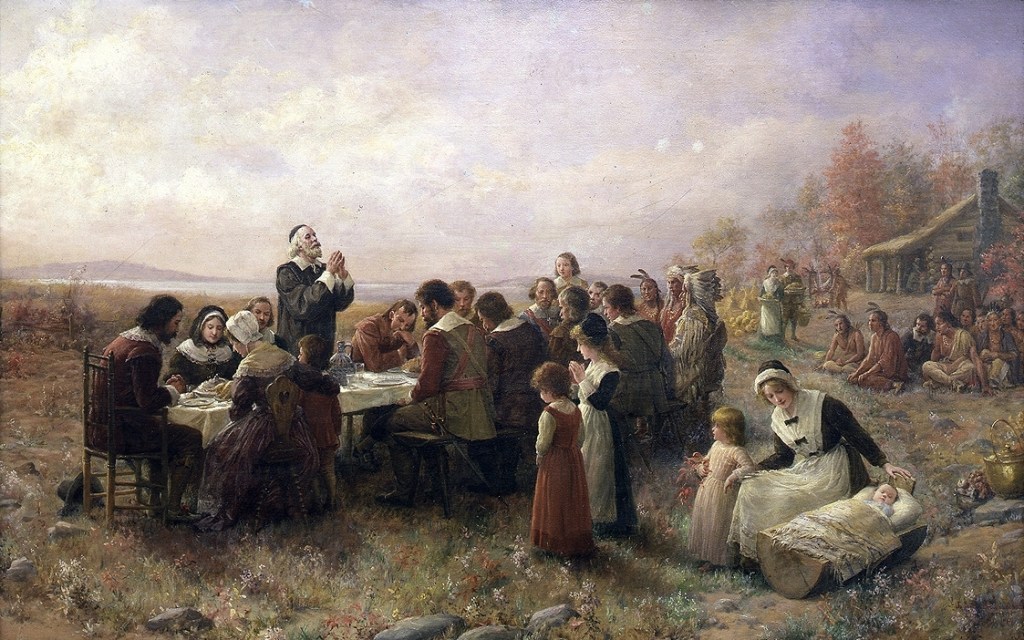
The cool blue waters of the Atlantic gradually changed their color from a darker hue, then eventually to an earthy greenish brown as the ship’s prow arrowed its way up the James River. The three-month sea journey from England had at last run its course and the crew of the Margaret rooted her anchor to the soft river bed below. They were barely twenty miles north of the Jamestown settlement at a site named for one the organizers of their enterprise, Richard Berkeley. With hoary, cold-numbed fingers and hands the sailors worked to lower the last of the baggage, stores, and anxious passengers into waiting longboats. Putting their backs in it, the oarsmen pulled hard against the imperative of the river’s brown tidal waters. Minutes later, the nose of each craft ground against the sandy shore littered with stones, sticks, and clam shells. The 38 passengers stepped ashore into the chilled silence of a cathedral of trees. As a group, they knelt reverently, and with lowered heads listened to their leader, Captain John Woodlief, satisfy the first dictate of their company’s charter.[1] In a voice that pierced the stillness and echoed with the words from Psalm 69, he proclaimed, “We ordain that this day of our ship’s arrival, at the place assigned for plantation, in the land of Virginia, shall be yearly and perpetually kept holy as a day of Thanksgiving to Almighty God.”[2] Together they gave thanks for their safe journey and arrival in the new land and beseeched the Lord for successful and bountiful harvests in the years to come. The date was December 4, 1619, and it was the first recorded Thanksgiving celebration on American soil.
Two years later, a second, better remembered, moment of Thanksgiving took place at Plymouth, Massachusetts in the autumn of 1621. There, the English settlers gathered with their Wampanoag neighbors to celebrate a good harvest, and to cement better relations between the groups. It would be this second celebration that became the stuff of historical legend and an inspiration for paintings, poems, and grade school pageants. But the two events, though separated by time and distance, testify to the praise and spiritual worship that was central to the early American identity. Often in endeavors such as these, the new arrivals paused to recognize the manifest grace of God that guided and protected them and provided for their needs. Just as those at the Berkeley Plantation had done, the settlers at Plymouth raised their voices to send thanks to their Heavenly Father for His “unspeakable mercy” and the provision of “meate and drinke for the nourishment of our weak bodies.”[3] It was in November of 1623 that the governor of the colony, William Bradford, proclaimed the 29th day of that month to be one of worship for all people “to render thanksgiving to the Almighty God for all His Blessings.”[4] This was as Chronicles advised, “Give praise to the Lord, proclaim His name; make known among the nations what He has done.” (1 Chronicles 16:8)
Over the years there has been some controversy concerning the actual first Thanksgiving celebration. On November 9, 1962, Virginia State Senator John J. Wicker responded to John F. Kennedy’s 1962 Thanksgiving Proclamation by noting that the President had given full credit to the Pilgrims of Plymouth, and neglected to mention the earlier event in Virginia. An apology arrived, via historian Arthur Schlesinger, who agreed with Wicker and wryly placed the blame on the “unconquerable New England bias” within the White House.[5] Kennedy corrected the error the following year by mentioning both Virginia and Massachusetts in that proclamation and pronouncing that the colonists all “gave reverent thanks for their safety, for the health of their children, for the fertility of their fields, for the love which bound them together and for the faith which united them with their God.”[6] These proclamations have continued since September 1789 when President George Washington named Thursday, November 26th of that year to be “A Day of Publik Thanksgivin’.”[7]
Thanksgiving celebrations in America are an annual tradition that reminds us of our deep spiritual connections with the early founders of our nation and provides us with an opportunity to give thanks for the bounty and freedoms we continue to enjoy as we put our trust in God. As Paul wrote, “Give thanks in all circumstances; for God’s will for you in Christ Jesus.” (1 Thessalonians 5:18)
[1] London Company was a Division of the Virginia Company. It gained its charter in 1606 by King James I as an enterprise to establish a colony in America as a wealth making venture for investors. The company listed a set of ten instructions for the settlers to execute upon their arrival. The first was to give thanks.
[2] For additional insights to the Berkeley celebration see H. Graham Woodlief’s “History of the First Thanksgiving,” Berkeley Plantation, accessed 4 November 2023, http://www.berkeleyplantation.com/first-thanksgiving.html
[3] King’s Chapel Prayer, link. https://www.kingschapel.net/a-pilgrims-prayer/
[4] “Governor Bradford’s First Thanksgiving Proclamation,” Apple Seeds, accessed 3 November 2023, https://www.appleseeds.org/thankgv6.htm
[5] Schlesinger served as special advisor and historian to the Kennedy administration from 1961 to 1963. “History of the First Thanksgiving,” Berkeley Plantation, accessed 4 November 2023, 2023, http://www.berkeleyplantation.com/first-thanksgiving.html
[6] Kennedy 1963 Proclamation link. American Presidency Project, John F. Kennedy, Proclamation 3560 – Thanksgiving Day, 1963, accessed 4 November 2023, https://www.presidency.ucsb.edu/documents/proclamation-3560-thanksgiving-day-1963
[7] “Congress Establishes Thanksgiving,” The Center for Legislative Archives, National Archives, accessed 6 November 2023, https://www.archives.gov/legislative/features/thanksgiving#:~:text=A%20few%20days%20later%2C%20President,celebrated%20under%20the%20new%20Constitution
 History and the Word
One response to “The First Thanksgiving”
wow!! 111The Sounds of Freedom
LikeLike