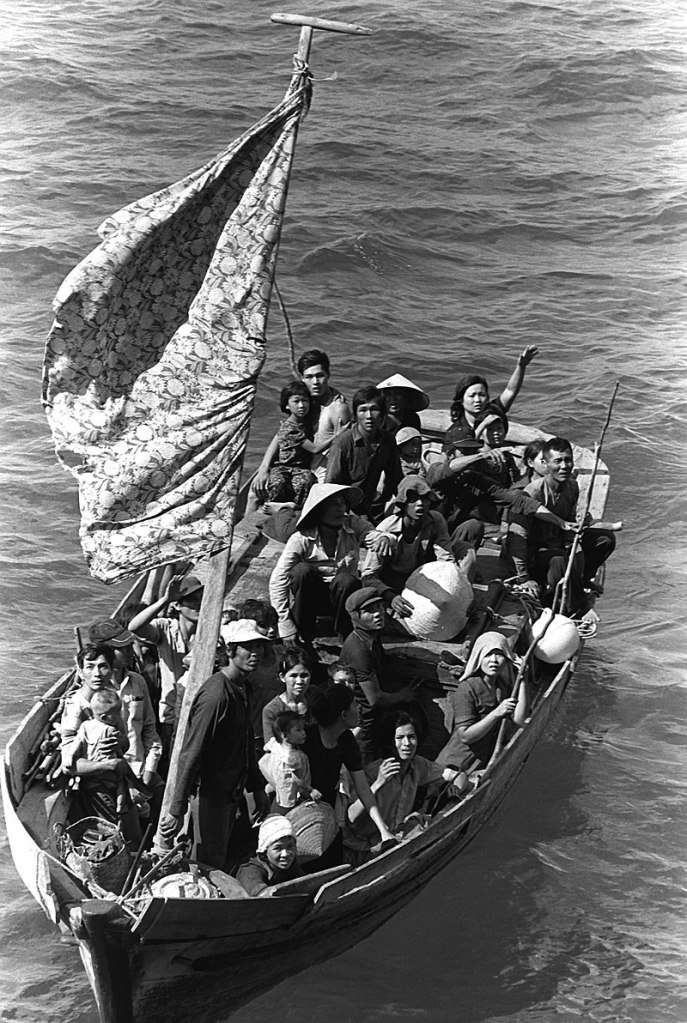
The fall of Saigon to Communist forces in April 1975 signaled the end of war that lasted over a decade. More than a million Vietnamese perished during that time, and the dark granite walls of the memorial in Washington, DC bear the names of over 58,000 Americans who gave their lives in that conflict.[1] Vietnamese who supported the United States and the South Vietnamese regime, faced the coming of dire consequences. If they remained in their country they would be subject to severe ostracism and probable incarceration in ‘re-education camps.’[2] If they fled, they would face the dangers of a journey by land, sea, or air, and an uncertain future. Regardless of the outcome, approximately two million South Vietnamese chose to leave their homeland.[3] Of that number, almost 800,000 chose to flee by boat in the years following the capitulation of the South. Theirs was perhaps the most hazardous choice. According to the records of the United Nations High Commissioner of Refugees (UNHCR) one third of these would perish, falling prey to exposure, dehydration, storms, and marauding pirates.
Among those who chose to flee by boat was Nguyen Van Vu. Gathering his family together on April 29, 1975 they made their escape on a small fishing boat. As the days drew on fear became a presence among them. They were far from land, making their way eastward in the China Sea hoping to spot a rescue vessel, but none came into view, not even another of the small craft carrying refugees. Van Vu soon found himself wrapped in dread. Had he made the right decision? As darkness descended on the second night the weather worsened. Adrift at sea Vu recalled that the “thunder, lightning, winds, and rains lashed us with unrelenting anger.”[4] Pitched violently about in the darkness with hope and courage quickly evaporating, Vu began to pray. As Jesus’s disciples who in their own storm tossed boat on the Sea of Galilee cried out to the Lord to save them, (Matthew 8:23-26) Vu prayed, “Oh, God, I know you are out there somewhere. Why, God, haven’t you come to rescue us?”[5] With the night wearing on and the storm raging, he continued in prayer and encouraged others to join him. Isaiah 43:2 reminds us of the Lord’s words, “When you pass through the waters, I will be with you; and when you pass through the rivers, they will not sweep over you.” So did Vu pray with the understanding and hope to “Be strong and of a good courage; be not afraid, neither be thou dismayed: for the LORD thy God is with thee whithersoever thou goest.” (Joshua 1:9)
Eventually, a US Navy ship spotted the small flashlight that Vu and the other passengers had been waving desperately into the darkness. After a harrowing three days at sea, far from land, with little food or water, they were rescued. The rest of his story unfolded as Vu could only wish for his family – transport to Guam then the United States, and welcomed support from a church group.[6] In time, a home and jobs would follow. Other Vietnamese refugees were not as lucky. Many perished at sea, some returned to Vietnam, and others languished in camps. But for Nguyen Van Vu the power of hope and reliance on prayer for the mercy of God prevailed. How many times in our storm tossed lives, in moments of desperation, have we turned to God in prayer?
[1] The exact number of names is 58, 318. See “The Names,” Vietnam Veterans Memorial Fund, accessed 23 August 2023, https://www.vvmf.org/About-The-Wall/the-names/ .
[2] One source cites the number of those sent to such camps as between 500,000 and one million. See “Reeducation Camps,” Vietnamese Heritage Museum, accessed 23 August 2023, https://vietnamesemuseum.org/our-roots/re-education-camps/.
[3] “Vietnamese Refugees Documents of Response,” Canadian Red Cross, accessed 23 August 2023, https://www.redcross.ca/history/artifacts/vietnamese-refugees-documents-of-response.
[4] See “Second Day at Sea,” excerpt from At Home in America by Nguyen Van Vu, in My Viet: Vietnamese American Literature in English, 1962-Present, ed. Janette Michele, 107.
[5] Ibid.
[6] Approximately 1.6 million Vietnamese refugees found new homes across the globe in the United States, Canada, Italy, Australia, Japan, Malaysia, Thailand, Hong Kong France, West Germany, and the United Kingdom during the period 1975 to 1997. See “The Resettlement of Vietnamese and Montagnard Refugees Residing in Thailand,” The National Bureau of Asian Research, accessed 23 August 2023, https://www.nbr.org/publication/the-resettlement-of-vietnamese-and-montagnard-refugees-residing-in-thailand/.



 History and the Word
Leave a comment