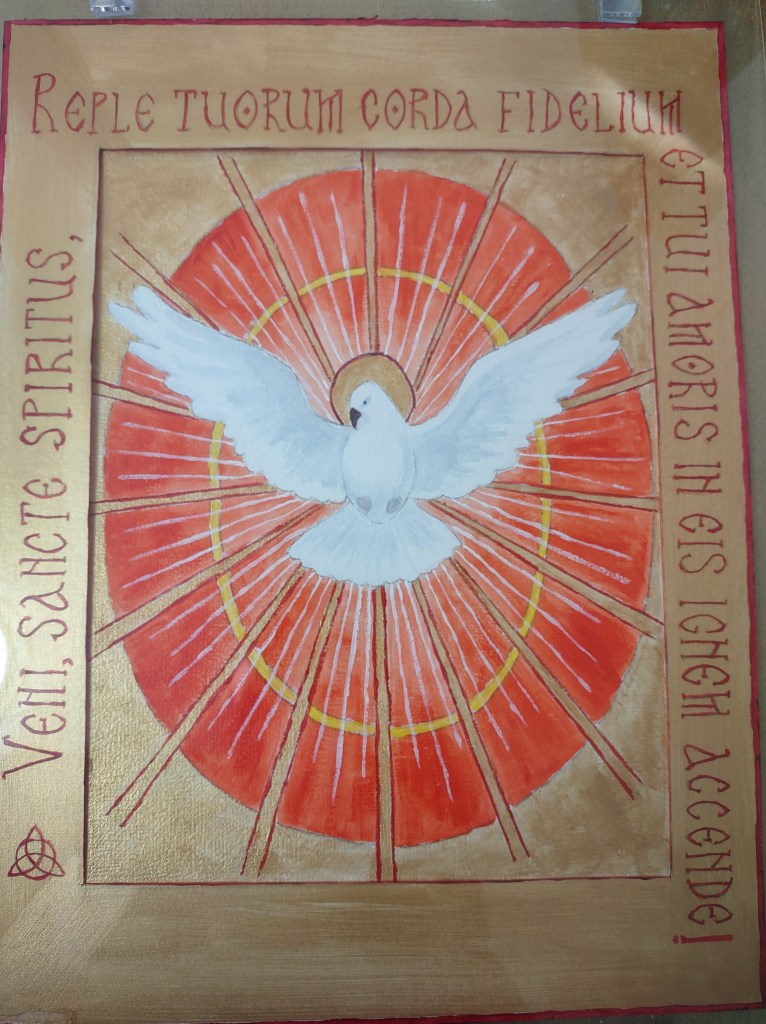
During the Baptism of Jesus, the Apostle John saw the Spirit of God coming down from above like a dove (Matthew 3:16). While John was only able to baptize with water, Christ baptized with the power of the Holy Spirit. This picture depicts the Holy Spirit, which is one with the father and Son, descending to give us grace and lead us to God. The prayer framing the image proclaims, “Come Holy Spirit, fill the hearts of your faithful and kindle in them the fire of your love.”
Original artwork by the author of this blog site, copyright 2024.
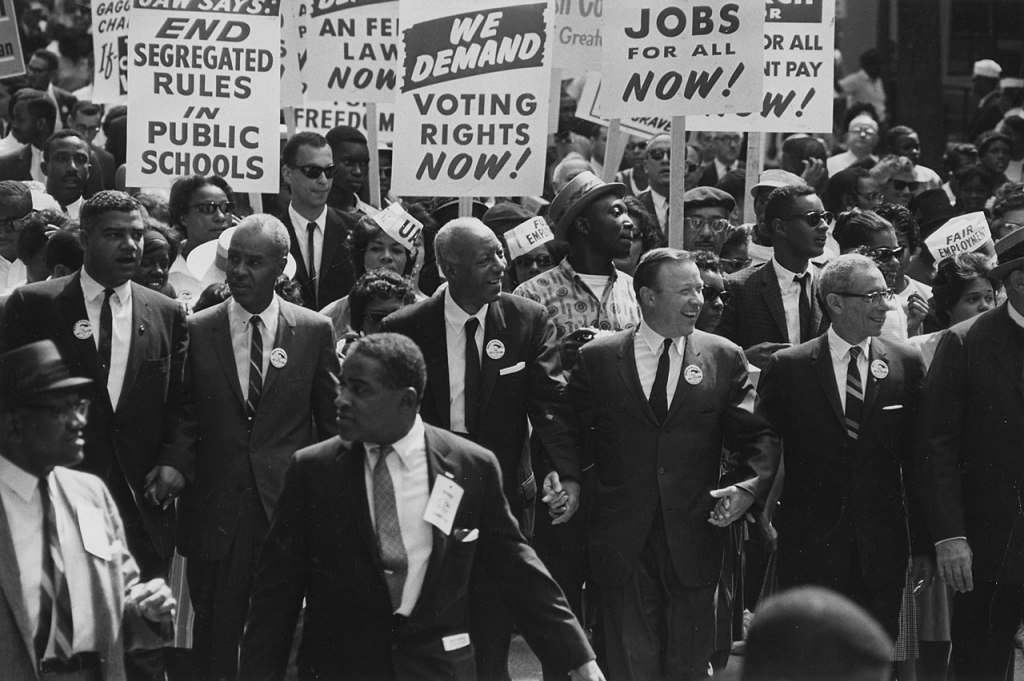
Night after night, during the long, hot summers of the early postwar decades, television screens across the nation cast glowing black and white images of the evening news into the family rooms of America. Reflected in the eyes of viewers were scenes of Civil Rights marchers moving along in solemn files, usually taunted and jeered at by crowds who flung ugly oaths at them. Occasionally, a rapid movement would catch the eye as a hostile bystander, intending harm, would hurl an object at them. Those not fortunate enough to dodge the missile suffered the attack, but the marchers’ spirits never seemed to waver under the heat of the assault. Police and authorities often stood back letting the mob’s aggressions play out, or took actions of their own to interdict the marchers by deploying water cannons, gas, and snarling dogs. Still, as these dramas played out, the marchers continued on, moving inexorably through the towns, cities, and segregationist citadels of the American South where the long-held cultural consensus had so long denied them the liberties they sought. Place names like Birmingham, Washington, Little Rock, Atlanta, Montgomery, and Selma served as markers along the trail they journeyed, and so also became etched as scars into the national psyche.[1]
The march on Washington, DC, August 28, 1963.
As they marched, they breathed words about freedom, justice, and the familiarity of suffering, and their songs rose high above them like prayers caught on the wind. The lyrics followed from Gospel verses that almost every man, woman, and child among them knew by heart. They were words that had echoed for centuries from church pulpits, lifting to the rafters, and settling upon the congregations. They were lyrics rooted in faith and hope, and anchored in Holy Scripture. It was the language of the American Civil Rights movement. By the 1950s, this music of faith had become the voice of that crusade. It made sense that it flowed from that foundation, the one place where enslaved and marginalized people could find refuge during their years of oppression. Songs such as “We Shall Not Be Moved” (Psalm 62:6) spoke of resolve, and “We Shall Overcome” (John 16:33) encouraged perseverance in the face of adversity. They emerged from scriptural passages, lifting souls up from despair and offering them hope, a hope that translated into the struggle for civil rights.
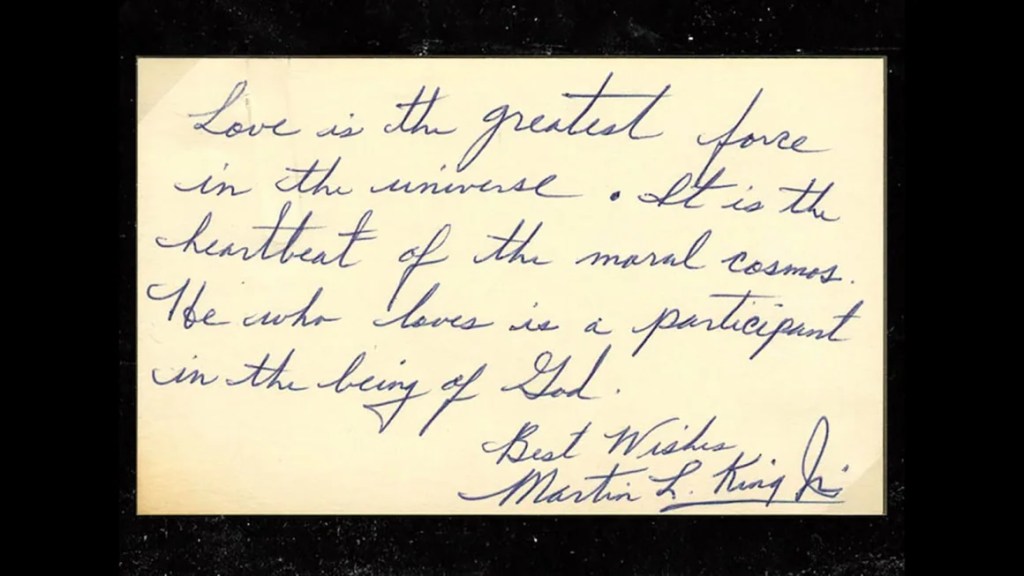
The leadership of the movement too came from that same place, through the clergy. Among them were the Reverend Dr. Martin Luther King, Jr., Ministers Fred Shuttlesworth, Ralph Abernathy, C.T. Vivian, and others who spoke of the redemptive powers of forgiveness (Romans 5:10), love (1 Peter 4:8), and suffering (Romans 8:18). Addressing packed churches these men drew their inspiration and energy from the Bible, using it to encourage the formation of a grassroots movement that would carry their cause forward, but they also eschewed violence in its name.[2] As Scripture cautions against joining the wicked in drinking the “wine of violence” (Proverbs 4:17) and against its incessant pervasiveness in all actions (Isaiah 59:1-6), King preached that violence “is immoral because it thrives on hatred rather than love. It destroys community and makes brotherhood impossible.”[3] He also offered a foil against the violence and hatred directed at them by writing, “Love is the greatest force in the universe. It is the heartbeat of the moral cosmos. He who loves is a participant in the being of God.”[4] Those ideas have been his legacy, and were the heart and soul of the early struggle for civil rights in the United States during the first postwar decades.
Those who teach and study history often fail to underscore the spiritual foundations of the incipient Civil Rights movement. The light of political and cultural turmoil of that day blinds many scholars to the reality of Scripture’s centrality to the cause. So, it is important to remember that it is in God’s word that we can always find encouragement to treat one another with justice and fairness. For Paul reminds us, as he had the Galatians, “There is neither Jew nor Greek, there is neither slave nor free person, there is not male and female; for you are all one in Christ Jesus.” (Galatians 3:28)
Handwritten note by Martin Luther King, Jr.(circa mid-1960s).
[1] Perhaps the best remembered march and gathering was at the Lincoln Memorial on August 28, 1963. It was the site of King’s famous “I Had a Dream” speech.
[2] For more about how the Bible influenced and shaped the tenets of the early Civil Rights Movement see Richard Lischer, “In the Mirror of the Bible,” Chapter 8, The Preacher King: Martin Luther King, Jr. and the Word that Moved America (New York: Oxford University Press, 2020).
Like vengeful thunder the rumble of musket volleys and cannon fire had rolled down the slope from Marye’s Heights across the short plain before the city of Fredericksburg. It was December 13, 1862 and wave after wave of Union soldiers had given their last full measure in a failed succession of assaults against the Confederate troops who rained fire upon them from behind the safety of a long stone wall.[1] The carnage was terrible, and both generals and privates in gray took no pleasure in the slaughter as more than 6,000 soldiers of the Army of the Potomac had died and hundreds more lay wrapped in the misery of their painful wounds, laying on the cold ground bound by exhaustion, loneliness, and fear.[2] Hour upon hour, their cries carried across the field on air hanging thick with acrid smoke. Their tortured prayers may have sought one of two ends, the final release that death might bring, or the hope of succor from a comrade.
Nineteen year old Sergeant Richard R. Kirkland of Company G, 2nd South Carolina Volunteer Infantry, heard their pleas and understood their pain having earlier witnessed such suffering at the First Battle of Manassas and then Savage’s Station near Richmond.[3] His commanding officer, Confederate Brig. Gen.Joseph B. Kershaw at first refused his request to go to their aid, but persistent petitions eventually brought the permission he desired. Gathering as many canteens as he could manage, Kirkland clamored over the stone wall and descended onto the field of carnage. He must have considered the significance of his actions as he navigated the torn landscape moving from one injured man to the next offering water to soothe parched throats and words of comfort to those with broken bodies. He might have been struck down by a Union sniper’s bullet who suspected him of robbing the dead, or been taken prisoner, but he continued for hours, returning to his own lines to refresh the canteens when needed, then travelling back to his self-appointed rounds. Stories tell of how he cradled some men as they drank and made others as comfortable as possible. He continued on, even as eventide’s cloak of darkness began to envelop the scene.
Perhaps it was a strong religious conviction that moved Kirkland to action with memory of the words of Paul to the Ephesians, “Be kind to one another, compassionate,” (Ephesians 4:32), or Peter’s call to us to “be of one mind, sympathetic, loving toward one another, compassionate, humble” (1 Peter 3:8). Determined, he moved among the wounded as with the spirit of an angel. To those he comforted he offered water, which appears as such an important constant that flows throughout the scriptures as life giving, healing, and cleansing. John baptized with it to remove our sins, Jesus offered water that quenches all thirst to the woman at the well (John 4:13-14), and He had a man wash away his blindness in the waters of the pool of Siloam (John 9:1-7). Even on that cold, cruel day in history, amid the suffering and dying, we can bear witness to the Holy Spirit moving in Man encouraging compassion, hope and life through the manifestation of His word.
Since that day there have been many historians, researchers, and investigators, who worked to separate the threads of Richard Kirkland’s story, wishing to weave a different narrative. Some say that Kirkland was not alone in his actions, that there were others also administering to the wounded. Some say he was not involved at all and that they cannot discover reputable records or witnesses to testify to his actions. Others blithely claim that he moved around the wall, not over it.
Often in our lives we are too ready to accept the telling of a story, or a version of that story, which seems plausible in a world that spins solely on the axis of a posteriori scientific reasoning without reaching for a deeper understanding of meaning and mystery that lie within the words and deeds. Whether Kirkland acted alone or with others, whether he made one trip among the wounded or many, does not matter. The thing that resonates in the tale is the reality that on that field of strife in December 1862, the Spirit of the Lord acted through a lone man, to show compassion to those who were broken in body and soul; a single light in the darkness.
( A memorial in the Fredericksburg and Spotsylvania National Park at the Sunken Road stands in commemoration of “The Angel of Marye’s Heights.”[4] It recognizes Richard Kirkland’s actions on that day and is dedicated to “National Unity and the Brotherhood of Man.” Other memorials that honor the event are at the National Civil war Museum, Harrisburg, PA, where is it is titled “Moment of Mercy,” and in the Quaker cemetery at Camden, SC where he is buried. The latter marker notes his resting place and sports a canteen that some recent visitor has hung over its shoulder.)
[1] These were the Union divisions of French, Hancock, Howard, and Sturgis attacking at 1:00 PM. Following them later in the afternoon at 3:30 PM were the divisions of Griffin and Humphreys. Directly opposing them was Longstreet’s Corps consisting of the divisions of McLaws, Ransom, and Pickett.
[2] BG Vincent J. Esposito, ed. The West Point Atlas of American Wars, Volume I, 1689-1900 (New York: Praeger, 1972), Map 73.
[3] The fighting at Savage Station occurred as the fourth of the Seven Days’ battles fought just east of Richmond in June 1862. Each side in the conflict lost approximately 500 men. See Shelby Foote, The Civil War, A Narrative: Fort Sumter to Perryville (New York: Vintage, 1986), 498-99.
[4] Sculptor Felix de Weldon created the statue for the National Park Service in 1965.

 History and the Word
Leave a comment