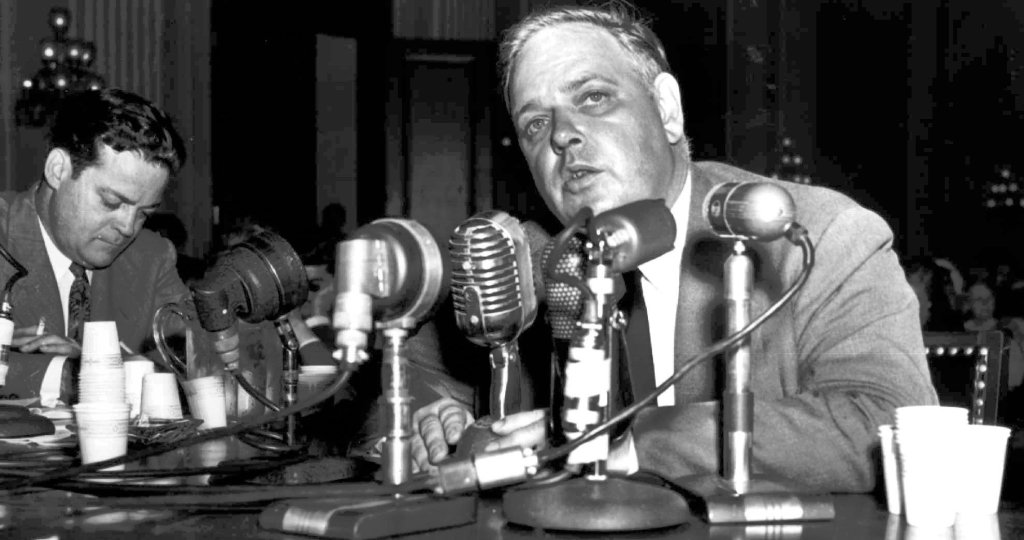
Using the cloak of darkness to shield their escape, Whittaker Chambers spirited his family away from their home on Mount Royal Terrace in Baltimore to a lonely house set far back from the road in Pikesville. Although this secret refuge was only 7 miles distant, Chamber’s desperate gambit changed his life forever. It was April 1938 and he had just taken the first step in quitting his role as an espionage agent and breaking with the Communist Party. Fearful of the deadly retribution meted out to other defectors, he and his wife had taken cautious steps over the preceding months in planning their flight. When the moment seemed right they bolted, disappearing into the night in a lone automobile followed by a small moving van, winding their way northward on less trafficked back roads.
Chamber’s association with the Communist Party began years earlier in 1925. It came at a time when he seemed most lost. Coming from a dysfunctional home he never felt secure or happy. Then, when he learned of his brother’s suicide, he felt his life had no direction or purpose. Searching for answers he turned to the illusory promise of Communism feeling that it filled the void by offering him a faith and vision for his life, however hollow it might be. Embracing its ideologies Chambers joined the party and gave himself over to its cause. Between 1927 and 1929 he established himself in New York City as a noted writer and editor for the New Masses and the Daily Worker.[1] Later, finding a position in Washington, DC as a Communist labor organizer, he began work for the GRU as a courier.[2] Using connections he had made with sympathetic individuals in the US government, Chambers obtained a large number of classified documents.[3] Between 1932 and 1938, he carried these to New York where he delivered them into the hands of his Communist bosses. Gradually, however, he became disillusioned with the Party and its operations. He and his wife never agreed with the expectation that effective Communist espionage agents should be childless. With two of their own, they always felt marginalized among members of their network. Chambers also could not understand Joseph Stalin’s callous disregard for life as purges and disappearances of dissidents continued to sweep through the Soviet Union during the 1930s. Nor could he understand the Molotov-Ribbentrop Pact that bound the Soviets with Hitler’s Reich, their arch-enemy.[4] By 1938 he felt betrayed, lost, and once again without a moral compass. As Jonah had called out to the Lord so did Chambers. (Jonah 2:3) It was at this time that he made his decision to break free from the atheist Communist apparatus.
Years later, in his bestselling memoir titled Witness, Whittaker Chambers admitted that “two things made the break and flight possible…the devotion of my wife…the other was a faith that, if I turned away from evil and sought good, I would not fail.”[5] In that way, he followed the advice of Proverbs 3:5-7 that encourages us to follow the Lord’s path and turn from evil. Casting back into his past he reached out for a touchstone from his youth, the comfort of the church. His returning faith in the Lord would come to fill the dark void in his life with a renewed light. As he wrote, “At the end, all men simply pray…without exception, we pray…because there is nothing else to do, and because that is where God is – where there is nothing else.”[6] Through contemplation and prayer, and with the help of friends, he redeemed his life. He and his family eventually returned to their Quaker roots and began attending Pipe Creek Friends Meeting House in Maryland. (Philippians 4:6-7) Whittaker Chambers had at last emerged from the pit. (Psalm 40:1-3)
The chronicle of Whittaker Chambers’ life is a story of Cold War espionage and a world divided into geo-political spheres. It traces his association with known Communist operatives in key pre-war US government posts, and it follows him into the halls of Congress where he testified before panels about his participation in a Communist spy ring, and in headline-grabbing fashion exposed persons still involved in espionage.[7] Following his rejection of Communism he became a well-recognized writer who produced conservative, anti-communist think pieces for both Time magazine and the National Review. He later received recognition and deep appreciation from his nation for exposing the Communist infiltration of the American government.[8] But most importantly, his story is the narrative of a man who came to a cross-road in this life and made a pilgrimage that took him away from a dark soulless ideology back into the saving light of the one Lord, just as scripture describes to us the path we must follow in our journey to redemption and salvation. (Hebrews 11:16; the Pilgrimage Psalms 120-134) As Whittaker Chambers cautioned, “There has never been a society or a nation without God. But history is cluttered with the wreckage of nations that became indifferent to God, and died.”[9]
[1] The New Masses was an American Marxist magazine that was in print from 1926 to 1948. The Daily Worker, founded by a collection of communists, socialists, and labor organizers, was a newspaper that served as one of the principle publications of the Communist Party of the United States (CPUSA), from 1924 to 1958.
[2] The GRU (Glavnoye razvedyvatel’noye upravleniye) was the main intelligence directorate of the Soviet Army from 1918 to 1992.
[3] Most of these individuals held posts in in the State Department, National Recovery Administration, Department of Labor, and the Department of the Treasury.
[4] The Molotov-Ribbentrop Pact, properly titled the “Treaty of Non-Aggression,” was a treaty between the Soviet Union and the German Reich who signed it into agreement on 23 August 1939. It included discussion of the partitioning of Central and Eastern Europe to the advantage of each nation.
[5] Whitaker Chambers, Witness (New York: Random House, 1952), 446. Chambers’ birth name was Jay Vivian Chambers, he later changed it to incorporate his mother’s maiden name (Laha Whittaker).
[6] Witness, 446.
[7] Among the individuals he exposed in 1948 was Alger Hiss, as well-respected official, who held a key position in the State Department. In combination with an investigation conducted by the House Un-American Activities Committee (HUAC) and hard evidence he provided, the government found Hiss and others to be guilty of espionage.
[8] President Ronald Reagan recognized Chambers’ contribution by awarding him the Presidential Medal of Freedom, posthumously, in 1984.
[9] Witness, 17.
 History and the Word