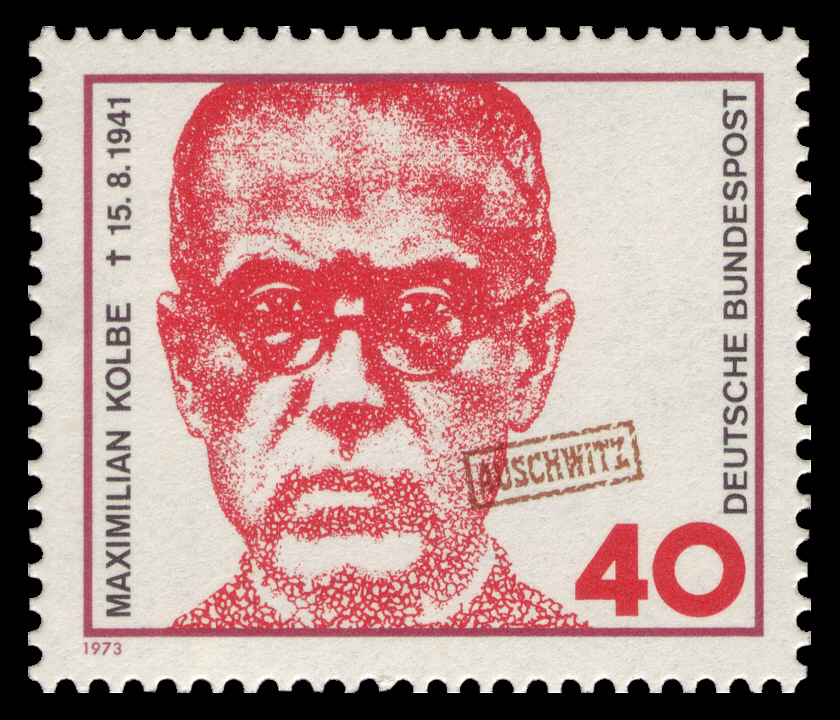
Franciszek Gajowniczek understood what he was facing. Pulled from the line with nine other prisoners to die, the cold reality of his fate gripped him.[1] Thinking only of his family at that moment he cried out, “My wife! My children!” His lamentations gave voice to a desperate but futile protest. Just then, from within the larger group, a solitary figure pushed its way to the front. In a calm and sure voice a wraithlike man offered an unexpected exchange, his life for that of Franciszek’s. It might have seemed a strange occurrence, but this was the death camp at Auschwitz-Birkenau, and in the summer of 1941 extraordinary events were not uncommon.[2] Perhaps the SS guards saw it as an amusing diversion. After all, life in the camp was often full of such absurdities. The exchange occurred, and Father Maximilian Kolbe took the place of Franciszek Gajowniczek. The punishment the priest purchased that day with his life was death by starvation. In this brave and noble action Father Kolbe had fulfilled the words of John 15:13 that remind us, “Greater love has no one than this: to lay down one’s life for one’s friends.”[3]
All ten prisoners that the guards selected found themselves sequestered in an underground bunker. Denied food and water their already weakened bodies deteriorated rapidly. According to a witness, every time the guards checked, they observed Kolbe encouraging the group with prayer. He refused to let them surrender their hope in the Lord or succumb to the thought that He was absent from their lives at that time, and so Kolbe continued to lead them spiritually to keep them from falling into despair. (Psalm 22) Nevertheless, the sentence levied by the Deputy Camp Commandant took little time to be effective. Just weeks after it began, only four men including Kolbe remained alive. Eventually, losing patience and anxious to bring the punishment to a conclusion, the Germans administered lethal injections of carbolic acid to the remaining few on 14 August 1941.
Prior to his arrest and transport to Auschwitz, Father Maximilian Kolbe was no stranger to the Nazis. Before the war he had served as the guardian of the Franciscan monastery at Niepokalanów, a place he help found a decade earlier. After September 1939, when the Nazis occupied Poland, he refused to sign the Deutsche Volksliste, which would have granted him conditional immunity from persecution.[4] This was a clear rejection of all they stood for. Soon after, he and the other Franciscans in the monastery began clandestinely harboring Polish refugees and Jews.[5] During the same period, Kolbe continued to publish religious works, including a number that were critical of the Nazis. Never did he shirk his responsibilities, maintaining a constancy of faith knowing that in the Lord his labor was not in vain. (1 Corinthians 15:58) Eventually, unable to tolerate Kolbe’s actions any longer, the Germans shuttered the Niepokalanów monastery on 17 February 1941 and arrested him and several others. After a three month stay at Pawiak prison in Warsaw, they transported him to the camp at Auschwitz, where he found himself in a special barracks designated for priests and religious persons. There, the Nazis meted out harassment that included routine beatings. Regardless, Kolbe continued to serve as a priest fulfilling his duties as best possible, much to the ire of the SS guards. In July, he made the fateful decision that saved Gajowniczek’s life.
Maximilian Kolbe’s sacrifice, bravery, and constancy of faith in the face of death offer inspiration to us all. Recognizing this, Pope John Paul II canonized him, and on 10 October 1982 declared him a Martyr of Charity. Today, a memorial statue of Father Kolbe stands adjacent to the Basilica Mniejsza on the grounds of the Niepokalanów friary.
[1] An earlier escape attempt prompted the camp’s deputy commander, SS–Hauptsturmführer Karl Fritzsch, to select ten prisoners to pay the price with their lives as a warning against future endeavors.
[2] Established in May 1940 the extermination and labor camp complex at Auschwitz-Birkenau, Poland alone accounted for the deaths of approximately one million Jews.
[3] See also 1 John 3:16, https://www.vatican.va/archive/ENG0839/__P12D.HTM
[4] The Deutsche Volksliste Category 1, Ethnically German. Despite his German ancestry, Kolbe refused to enroll and self-identify under this category. The listing was a device used by the Nazi Party to categorize inhabitants of the occupied territories. There was a total of four categories, with 2-4 retaining lesser privileges and liberties.
[5] Approximately 2,000 Jews found refuge there during this time.
 History and the Word
Leave a comment